
LimX Luna Humanoid Robot
In stock
- BRAND:
- LIMX
- MODEL:
- OLI LITE
- ORIGIN:
- China
- Warranty:
- 12 MONTHS
- AVAILABILITY:
- SUBJECT TO AVAILABILITY
- SKU:
- LimX-Luna
LimX Luna Humanoid Robot: Overview, Specifications, and Capabilities
Luna represents a meaningful evolution in LimX Dynamics' humanoid portfolio. While the company's established Oli platform is built around industrial-grade capability and rugged all-terrain mobility, Luna is engineered with a distinctly different philosophy: approachable aesthetics, natural movement, and the kind of social and expressive agility required in service, entertainment, and research environments. LimX has described Luna as being specifically designed for interactive and performance scenarios, positioning it as a complement to rather than a replacement for its existing lineup. The robot is built on the same general architecture as LimX's full-size humanoid Oli, but incorporates comprehensive upgrades across its mechanical configuration, joint capability, hardware systems, and functional design. With 33 degrees of freedom, it surpasses the 31 DoF found in the Oli platform and offers notably more nuanced articulation for complex motion sequences and human-like gait patterns.
Design and Features
Physical Form and Aesthetic Direction
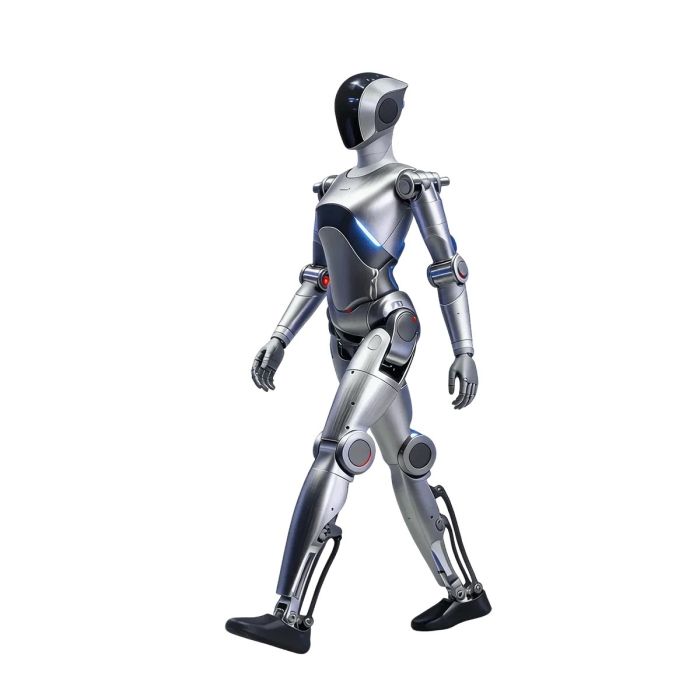
Luna's most immediately distinctive quality is its visual and physical design language. Where Oli is known for an industrial metallic silver finish suited to environments like construction sites and manufacturing floors, Luna adopts what LimX calls a "lifestyle-oriented" aesthetic. The robot features a sleek silhouette with organic, curved forms and a rounded head, creating an appearance that is approachable rather than utilitarian. LimX has stated that this design choice reinforces Luna's intended role in social and service contexts, where a robot's visual presence affects how humans relate to it in real time.
Luna stands approximately 165 centimeters tall, matching common humanoid proportions, and weighs around 55 kilograms with its battery installed. Its dimensions place it within the 165 x 55 x 30 centimeter frame range, making it comparable to a slender adult human figure. These proportions allow the robot to navigate standard door widths, use furniture and counters designed for human use, and operate in spaces without structural modification.
Degrees of Freedom and Joint Architecture
Luna achieves 33 degrees of freedom, a notable upgrade from the 31 DoF found in the Oli platform. This additional articulation enables more complex motion patterns, a more natural gait, and finer expressive control across the upper body. LimX attributes the expanded DoF to upgrades in the robot's mechanical configuration and joint system, though a full joint-by-joint breakdown had not been published as of early 2026.
The joint design is consistent with LimX's established approach of using hollow actuator design and high torque-density actuators, a combination the company developed for Oli and refined across its full platform lineup. These actuators enable full-body balance across a wide range of motion, which was evident in Luna's public demonstrations of walking stability and illusion turn execution.
Walking and Locomotion
Luna can walk at speeds of up to 5 kilometers per hour, equivalent to approximately 1.4 meters per second. This is consistent with a brisk human walking pace and is suitable for navigation in shared environments like retail floors, exhibition halls, and corridors. The robot's walking stability during its March 2026 debut drew positive attention from both robotics observers and the general audience at the Taobao Influencer Festival, with the performance described by Interesting Engineering as showcasing "pinpoint balance and fluid motion control."
Technology and Specifications
Sensing and Perception
Luna's sensory configuration centers on depth perception and visual understanding across multiple fields of view. The robot carries dual Intel RealSense D435i depth cameras, one mounted at head level and one at chest level, providing overlapping depth perception that helps the robot track objects and understand its spatial relationship to people and obstacles from two distinct vantage points. RGB cameras supplement the depth cameras for object recognition and visual interaction tasks.
A 6-axis self-developed IMU (Inertial Measurement Unit) provides continuous orientation and acceleration data, supporting balance control during walking, turning, and dynamic maneuvers. Joint encoders feed real-time positional feedback through the control loop, allowing the motion system to make continuous micro-adjustments during movement.
For navigation, Luna employs vision-LiDAR fusion and Visual SLAM (Simultaneous Localization and Mapping). This combination allows the robot to build and maintain a real-time map of its environment, track its position within that map, and update both as conditions change. LiDAR provides reliable depth data in varied lighting conditions, while visual SLAM integrates camera-based features for richer environmental context. Together, they allow Luna to navigate dynamically populated spaces with more confidence than camera-only or LiDAR-only systems would allow.
Computing Infrastructure
The computing architecture behind Luna draws from the same infrastructure used in the Oli platform. The Oli system runs a main computing backpack powered by an NVIDIA AGX Orin chip, while perception computing is handled by an Orin NX module rated at 157 tera operations per second. Given that Luna is built on the Oli platform's general architecture, its computing baseline is expected to be comparable, though LimX had not published a dedicated Luna computing specification sheet as of early 2026.
The robot runs on a Linux-based software environment using ROS 2 and Python. ROS 2 (Robot Operating System 2) is the standard development framework used across the global robotics research community, and its presence in Luna's stack makes the robot accessible to a wide developer audience. Researchers and engineers can build custom interaction scripts, autonomous behavior pipelines, and robotic applications without relying exclusively on LimX's proprietary tools.
Key Technical Specifications
| Specification | Detail |
|---|---|
| Height | Approximately 165 cm |
| Weight (with battery) | Approximately 55 kg |
| Dimensions | ~165 x 55 x 30 cm |
| Degrees of Freedom | 33 |
| Maximum Walking Speed | 5 km/h (1.4 m/s) |
| Depth Cameras | Dual Intel RealSense D435i (head + chest) |
| Additional Cameras | RGB cameras |
| IMU | 6-axis self-developed |
| Navigation | Vision-LiDAR fusion, Visual SLAM |
| Operating System | Linux, ROS 2, Python |
| AI Framework | LimX COSA (Cognitive OS of Agents) |
| Motion Learning | VideoGenMotion (VGM) framework |
| Operation Modes | Teleoperation, full autonomy, hybrid |
| Availability | Not yet available for purchase (as of early 2026) |
COSA: The Agentic Operating System
A core part of what distinguishes Luna from conventional humanoid platforms is its integration of COSA, the Cognitive OS of Agents, which LimX launched on January 12, 2026. LimX describes COSA as the first operating system designed from the ground up for humanoid robots operating in real-world environments, rather than an adaptation of general-purpose computing or robotics middleware.
COSA introduces two particularly significant capabilities. The first is Semantic Memory, which allows the robot to retain contextual information about its environment and use it in subsequent interactions without explicit re-prompting. Rather than treating every encounter as a blank slate, the robot builds on accumulated experience. The second is coordinated whole-body control, enabling simultaneous manipulation and locomotion. A robot running COSA can walk while handling objects rather than having to choose between the two.
The system is structured as a three-layer architecture. A cerebellum foundation model generates real-time full-body motion, allowing dynamic posture adjustment rather than reliance on a library of preset movements. Above that, a mid-level skill library handles task-level behaviors like picking up objects, navigating to a location, or opening a door. At the highest level, a cognitive planning layer understands natural language instructions, assesses priority, and coordinates sequences of actions across the lower layers in real time.
In a live demonstration using Oli, when the robot was mid-task delivering water and received a new instruction to collect parcels, COSA's cognitive layer reassessed priority, replanned the route, completed the original task, then addressed the new request, all without stalling or requiring human intervention to reset the robot's state. This kind of dynamic, non-scripted adaptation is what LimX positions as the fundamental differentiator of the COSA approach relative to other robot operating environments.
VideoGenMotion Framework
Luna's ability to learn and replicate complex human movements draws on LimX's VideoGenMotion (VGM) framework, which allows the robot to imitate human motion directly from video inputs rather than requiring hand-authored motion capture data or scripted trajectories. This significantly reduces the cost and time required to teach Luna new movement patterns. A choreographer, a physical therapist, or an event designer could, in principle, capture a movement on video and use it as training input for Luna without deep robotics engineering involvement.
This capability is particularly relevant for the service and entertainment applications Luna is designed to address, where movement repertoire, expressiveness, and the ability to rapidly learn new routines carry real commercial value.
Applications and Use Cases
Service and Hospitality
Luna's approachable aesthetic and natural movement make it well-suited to front-of-house service environments. Hotel lobbies, airport welcome areas, corporate reception spaces, and retail flagships can deploy Luna for guest greeting, wayfinding assistance, and interactive engagement. Its wake-responsive interaction capabilities and COSA-powered natural language understanding allow it to hold context-aware conversations rather than returning scripted responses.
Entertainment and Live Performance
The Taobao Influencer Festival debut was a deliberate signal of Luna's fitness for live performance contexts. Its ability to execute choreographed sequences, perform expressive walks, and execute gymnastic-style movements like the illusion turn makes it viable for brand activations, product launches, themed events, and public exhibitions. VideoGenMotion further supports rapid repertoire expansion, allowing event teams to train new movements from video without extended technical development cycles.
Research and Embodied AI Development
Luna's ROS 2 compatibility, open developer environment, and integration with the COSA operating system make it a capable platform for academic and institutional research into embodied AI, human-robot interaction, locomotion control, and manipulation learning. Its hybrid operation modes, supporting teleoperation, full autonomy, and mixed approaches, give researchers the flexibility to study different control paradigms on a single platform.
Logistics Experiments and Light Industrial Pilots
While Luna is not primarily positioned as an industrial robot in the same way as Oli, its loco-manipulation capabilities and whole-body control allow it to participate in logistics research and light task environments. Fetching objects, carrying items between locations, and performing simple manipulation sequences are within its operational scope, making it appropriate for logistics pilot programs in controlled settings.
Advantages and Benefits
Social and aesthetic design intent. Unlike most humanoid robots that optimize purely for functional performance metrics, Luna is deliberately designed to function well in environments where appearance and social approachability affect outcomes. Its organic, curved aesthetic lowers the perceived threat of a robotic presence and makes initial human-robot interaction feel more natural.
Higher DoF than its predecessor. Luna's 33 degrees of freedom surpasses the Oli platform's 31 DoF, enabling more expressive upper body movement and a more human-like gait. This matters in service and entertainment contexts where movement quality is directly visible to audiences and users.
VideoGenMotion for rapid skill acquisition. The ability to learn movements from video is a practical advantage in commercial deployment scenarios where repertoire needs to be updated frequently, seasonally, or in response to event requirements, without the overhead of full motion capture pipelines.
COSA operating system integration. The Semantic Memory and whole-body coordination capabilities built into COSA give Luna a more capable cognitive foundation than many contemporaries, enabling genuine multi-task adaptation in dynamic environments rather than linear script-following.
Frequently Asked Questions
What is the LimX Luna humanoid robot?
The LimX Luna is a full-size general-purpose humanoid robot developed by LimX Dynamics, a Shenzhen-based robotics company. Built on the same general architecture as LimX's existing Oli humanoid platform but with upgraded mechanical configuration and a lifestyle-oriented aesthetic, Luna is designed specifically for interactive and performance scenarios, including service environments, entertainment, and embodied AI research. It made its public debut at the Taobao Influencer Festival in March 2026.
How does the LimX Luna robot work?
Luna operates using LimX's COSA (Cognitive OS of Agents), an agentic operating system that integrates natural language understanding, semantic memory, and real-time whole-body motion control. Its sensory array, including dual Intel RealSense D435i depth cameras, RGB cameras, a 6-axis IMU, and Visual SLAM-enabled LiDAR fusion, allows the robot to perceive and navigate its environment dynamically. It can be operated via teleoperation, full autonomous control, or hybrid modes, and uses the VideoGenMotion framework to learn new movement patterns directly from video inputs.
What makes the LimX Luna different from the LimX Oli?
While Luna and Oli share a common underlying hardware architecture, they are designed for distinct contexts. Oli prioritizes industrial ruggedness, heavy-load capacity, and performance in demanding physical environments like construction sites and logistics facilities. Luna is designed for service, entertainment, and research settings, featuring a more approachable, organic aesthetic, 33 degrees of freedom (compared to Oli's 31), and a motion repertoire oriented toward natural, fluid human interaction.
What is the LimX COSA operating system and why does it matter for Luna?
COSA, which stands for Cognitive OS of Agents, is an operating system developed by LimX Dynamics and launched in January 2026. It is designed specifically for humanoid robots operating in real-world environments, integrating three functional layers: a cerebellum-level motion model for real-time full-body movement, a skill library for task-level behaviors, and a high-level cognitive planner for natural language understanding and dynamic task reprioritization. Its Semantic Memory feature allows robots to retain environmental context across interactions, while whole-body coordination enables simultaneous locomotion and manipulation. For Luna, COSA provides the cognitive infrastructure needed to function effectively in dynamic, unscripted service and research settings.
What is VideoGenMotion and how does Luna use it?
VideoGenMotion (VGM) is LimX Dynamics' proprietary motion learning framework that allows a robot to replicate complex human movements by learning from video inputs rather than hand-coded motion scripts or expensive motion capture sessions. For Luna, this means that new movement routines, choreography, or interaction gestures can be added to the robot's repertoire quickly and with relatively low technical overhead. It is particularly valuable in entertainment and service contexts where movement quality and variety are important to the robot's commercial value.
Summary
The LimX Luna humanoid robot is a notable development in the emerging category of service-oriented, aesthetically considered humanoid platforms. Built by LimX Dynamics, a Shenzhen company with total disclosed funding of approximately $296 million and a track record stretching from modular legged robots to the Oli humanoid and the COSA operating system, Luna combines a lifestyle aesthetic with genuine technical depth. Its 33 degrees of freedom, vision-LiDAR fusion navigation, COSA-powered cognitive architecture, and VideoGenMotion learning framework position it as a platform capable of growing well beyond its debut demonstrations. For researchers, enterprise service operators, and robotics observers tracking the next generation of deployable humanoids, Luna is a platform worth watching closely.