
Unitree H1 Humanoid Robot - Fastest Robot in the World
In stock
- BRAND:
- UNITREE ROBOTICS
- MODEL:
- H1
- ORIGIN:
- China
- AVAILABILITY:
- ALLOW 4-6 WEEKS FOR DELIVERY
- SKU:
- Unitree-H1
Unitree H1 Humanoid Robot - Fastest Robot in the World
Full-size humanoid architecture
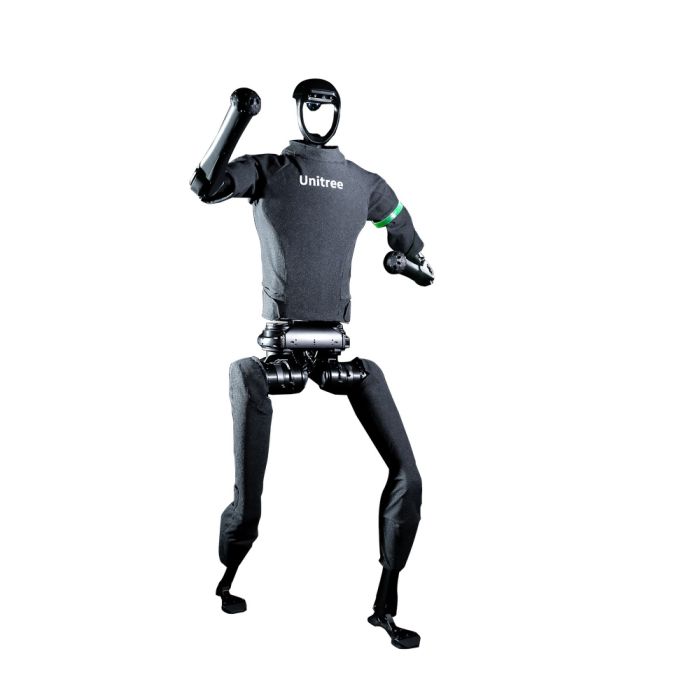
According to Unitree’s official comparison table, the original H1 stands about 180 cm tall and weighs about 47 kg. That makes it a full-size humanoid robot with a distinctly lightweight body relative to many competing full-height humanoids. Its proportions are designed for human-scale environments, but its relatively low mass also supports the speed and agility for which the platform became known.
High-performance locomotion focus
The H1’s design clearly prioritizes dynamic movement. Unitree’s official page lists a moving speed of 3.3 m/s and potential mobility over 5 m/s, while recent April 2026 news coverage reports that a modified H1 reached 10 m/s in a sprint test. In that reported test, the company removed the robot’s head and hand components to reduce weight and improve speed. This supports the idea that H1 was engineered with unusually strong locomotion potential from the start.
Simplified upper body compared with H1-2
The original H1 is also mechanically simpler than the later H1-2. Unitree’s official H1/H1-2 comparison shows the H1 with 4 DoF per arm, compared with 7 DoF per arm on the H1-2. This tells an important story about the H1’s design priorities: it was built more as a speed- and mobility-first humanoid, not primarily as a dexterous manipulation platform.
Universal humanoid positioning
Despite that mobility-first orientation, Unitree still presents H1 as a universal humanoid robot, not as a specialized sprinting machine. The company’s public product structure places H1 alongside H1-2, H2, G1, and R1 in the humanoid category, indicating that H1 belongs to a broader effort to build general-purpose humanoid platforms rather than one-off performance demos.
Technology and Specifications
Degrees of freedom and body structure
Unitree’s official H1 page lists the original H1 with 19 total degrees of freedom, including 6 DoF per leg and 4 DoF per arm. That is lower than the 27 DoF listed for H1-2, again reflecting the original H1’s simpler upper-body architecture. The official table also indicates a narrower and lighter body, reinforcing that H1 was optimized around motion efficiency.
Joint torque and actuator performance
The H1’s official specification includes knee torque of about 360 N·m, hip joint torque about 220 N·m, ankle torque about 59 N·m, and arm joint torque about 75 N·m. Unitree also highlights a peak torque density of 189 N·m/kg on the platform page. These are unusually aggressive figures for a humanoid in this weight class and help explain the robot’s strong acceleration and running ability.
Battery and power system
Unitree states that H1 uses a 15 Ah battery, 0.864 kWh capacity, and maximum voltage of 67.2 V. This official battery specification is shared across the H1/H1-2 comparison and reflects a powertrain built to support high-output leg actuation and dynamic locomotion rather than only slow walking or static pose control.
Perception and computing
The official H1 / H1-2 page emphasizes 3D LiDAR + depth camera for the family’s depth perception, although the H1-specific public table is less explicit about perception emphasis than the H1-2 entry. Unitree also lists standard and optional compute configurations for the family, including Intel Core i5, Intel Core i7, and optional NVIDIA Jetson Orin NX configurations in higher setups. This positions the H1 as a research-capable platform as well as a mobile one.
World-record and sprint-speed context
The most conservative official speed number remains 3.3 m/s, because that is what Unitree currently publishes on the official H1 page and explicitly labels as “world record.” More recent April 2026 press coverage reports 10 m/s, but those reports describe a special sprint test and note modifications to the robot, including removal of head and hand components. Since the newer number appears in reporting rather than on the official product page, it should be treated as a later reported sprint achievement rather than the baseline catalog specification.
Applications and Use Cases
The H1 is most naturally suited to humanoid robotics research, locomotion studies, whole-body control, and embodied AI development. Unitree’s official product presentation, compute options, and continued positioning of H1 in its humanoid lineup all suggest that it is meant as a development platform rather than a consumer novelty robot.
Because the original H1 emphasizes movement more than dexterous arm work, it is especially relevant to teams interested in high-speed biped locomotion, dynamic stability, balance recovery, and sports-like robot motion. The robot’s public speed claims and sprint demonstrations support that interpretation strongly.
The H1 also plays a public-facing demonstration role. Unitree’s official site and news presence continue to feature the H1 family as part of the company’s humanoid identity. In that sense, H1 has become a benchmark platform for how fast and dynamically capable a commercially surfaced humanoid can be.
Advantages / Benefits
One of the H1’s clearest advantages is its exceptional speed relative to humanoid peers. Even using only Unitree’s official product-page number of 3.3 m/s, the company frames H1 as holding a world record. The later April 2026 sprint reporting, if treated as a special-case performance result, only strengthens the H1’s reputation as one of the fastest humanoid robots yet shown publicly.
A second advantage is its lightweight full-size build. At about 47 kg and 180 cm, the H1 combines human-scale dimensions with unusually low body mass. That improves agility and likely contributes significantly to its running ability and fast directional motion.
A third advantage is strong actuator performance. The robot’s high joint torque figures and Unitree’s emphasis on torque density indicate a platform built around powerful lower-body dynamics. For researchers or developers focused on legged motion, that is one of the H1’s most important features.
FAQ Section
What is the Unitree H1 Humanoid Robot?
The Unitree H1 is Unitree Robotics’ first publicly released universal humanoid robot. It is a full-size humanoid designed with a strong focus on locomotion, speed, and dynamic movement.
How fast is the Unitree H1?
Unitree’s official product page lists the H1 at 3.3 m/s (world record) with potential mobility over 5 m/s. Separate April 2026 reporting says a modified H1 later reached 10 m/s in a sprint test.
Why is the Unitree H1 important?
The H1 is important because it helped establish Unitree’s humanoid program and became known for unusually fast humanoid locomotion. It remains one of the most speed-focused full-size humanoids publicly surfaced by a robotics company.
What are the benefits of the Unitree H1?
Its main benefits include very high humanoid running speed, lightweight full-size construction, strong joint torque, and value as a research platform for locomotion and embodied robot development.
Is the Unitree H1 really the fastest robot in the world?
That claim needs qualification. Unitree officially calls the H1’s 3.3 m/s speed a world record on its product page. More recent reporting says the H1 reached 10 m/s in a modified sprint test. So it is accurate to describe H1 as one of the fastest humanoid robots ever reported publicly, while being careful not to overstate unverified categories beyond humanoid robotics.
Summary
The Unitree H1 Humanoid Robot is best understood as a landmark first-generation universal humanoid from Unitree, defined above all by speed, lightweight full-size construction, and high-performance lower-body actuation. Officially, Unitree lists the H1 at 3.3 m/s (world record), while later 2026 reporting says a modified H1 reached 10 m/s in sprint testing. Even without overstating the claim, the H1 clearly belongs in any serious discussion of the fastest humanoid robots ever publicly demonstrated.
Specifications
Movement
General
What's included
Related Products
Out of stock