
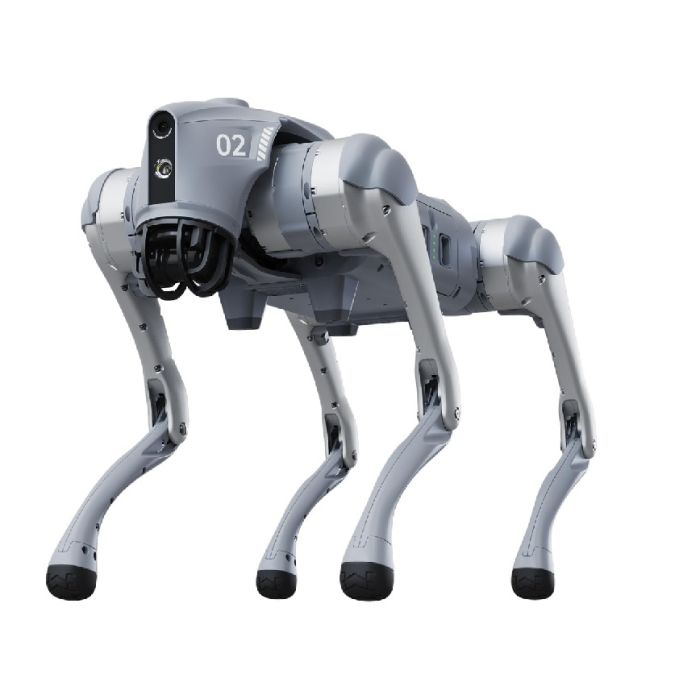
Unitree Go2 PRO Quadruped Robot Dog
En stock
- MARQUE:
- UNITREE ROBOTICS
- MODÈLE:
- GO2 PRO
- ORIGIN:
- Chine
- Warranty:
- 12 MOIS
- AVAILABILITY:
- SUBJECT TO AVAILABILITY
- SKU:
- Unitree-GO2-PRO
Buy now, pay later
Unitree Go2 PRO Quadruped Robot Dog
Three and a half metres per second, eight kilograms of payload and 4D LiDAR perception, on a fifteen-kilogram robot one person can carry to site. The Go2 Pro is the tier most serious work starts at, and the reason is a full metre per second more speed than the Air for a modest step in price.
What it is
The Unitree Go2 Pro is the mid-tier configuration of Unitree's second-generation quadruped: about 15 kg, a top speed of 3.5 m/s, a working payload of about 8 kg with roughly 10 kg maximum, an 8,000 mAh battery giving one to two hours, and multi-sensor perception including Unitree's 4D LiDAR. It sits between the entry-level Air and the higher-performance X and EDU tiers.
Why the Pro rather than the Air
Speed, and it is not a marginal difference. The Air tops out at 2.5 m/s; the Pro reaches 3.5. On a patrol route, an inspection round or any task where the robot covers ground, forty per cent more speed changes how much work fits into a battery charge. Payload rises modestly too. For teaching, demonstration and most research the Pro is the sensible floor, and the Air makes sense mainly where budget is the binding constraint.
Where the Go2 Pro sits in the range
The Go2 comes in four tiers that share one 15-kilogram chassis. What changes is speed, payload, battery and — on the EDU — development access.
| Tier | Speed | Payload | Battery |
|---|---|---|---|
| Go2 Air | 2.5 m/s | About 7 kg, up to about 10 kg | 8,000 mAh, 1 to 2 hours |
| Go2 Pro | 3.5 m/s | About 8 kg, up to about 10 kg | 8,000 mAh, 1 to 2 hours |
| Go2 X | 3.7 m/s, about 5 m/s burst | About 8 kg, up to about 12 kg | 8,000 mAh, 1 to 2 hours |
| Go2 EDU | 3.7 m/s, about 5 m/s burst | About 8 kg, up to about 12 kg | 15,000 mAh, 2 to 4 hours |
Two things are worth noticing in that table. The jump from Air to Pro is a full metre per second of speed for a modest step in price, which is why the Pro rather than the Air is the usual starting point for serious work. And the EDU is the only tier with the larger 15,000 mAh battery as standard — that pack is also sold separately and fits the others, so a long runtime does not by itself require buying the EDU.
Published sources vary slightly on which 4D LiDAR each tier carries, so confirm the sensor on your quotation rather than assuming it from the tier name.
Unitree Go2 Pro specifications
| Specification | Value |
|---|---|
| Weight | About 15 kg |
| Payload | About 8 kg, up to about 10 kg maximum |
| Top speed | 3.5 m/s |
| Battery | 8,000 mAh — 1 to 2 hours depending on use |
| Perception | Multi-sensor, with Unitree 4D LiDAR options — confirm the sensor on your quotation |
| Tier | Go2 Pro — mid-tier configuration |
Figures follow published specifications and vary by production batch. Confirm the exact configuration and sensor package on your quotation before ordering.
Who buys it
- University and research laboratory work
- Teaching and demonstration programmes
- Startups prototyping quadruped applications
- Inspection and survey pilots
- Buyers needing portability and a comparatively accessible price
How to choose
Buy the Pro if you want the Go2 platform with usable speed and payload. Step up to the X for a slightly higher top speed and a 12 kg maximum payload, or to the EDU if you need development access and the larger 15,000 mAh battery as standard. Note that the long-range battery is sold separately, so endurance alone is not a reason to move tiers. Compare the whole field in our robot dogs and quadrupeds category.
Safety and handling
A 15-kilogram quadruped moving at 3.5 metres per second carries real momentum. It is research and commercial equipment, not a consumer toy, and the industrial robot safety standards do not cover it, so the duty of care sits with the operator.
Keep a trained operator with the controller and stop function within reach whenever the robot is powered, keep bystanders out of its path at speed, and complete a written risk assessment before operating anywhere the public can reach. Lithium batteries are regulated dangerous goods in transit, which affects how spares ship and how quickly.
Deployment and running costs
Runtime is the thing to plan around: one to two hours on the standard 8,000 mAh pack, depending on how hard the robot works. A spare pack is the cheapest useful upgrade, and the 15,000 mAh long-range battery is sold separately if you want closer to the EDU tier's endurance. Foot pads and protective brackets are genuine consumables on a robot that works outdoors or is handled by students. Related parts are listed under robot accessories. International buyers should add duty and import charges.
Import and delivery
Units ship from the manufacturer and lead times follow production batches rather than a fixed schedule. Lithium batteries restrict some routes and add documentation, though at about 15 kg this is one of the easier robots to ship. Tell us the destination country when you enquire and we will confirm delivered cost, a realistic lead time and the paperwork required before you commit.
Support before and after the sale
Before you buy, our team will confirm the tier and the sensor package against the work you intend to do — published sources differ on which LiDAR each Go2 tier carries, so we put that in writing rather than leaving it to the tier name. After delivery, we help with training, set up and ongoing support.
Where to buy
This item is listed above with current price and availability, alongside the rest of the Go2 Pro range and its accessories. Order directly, or contact our team for a formal quotation including delivery to your country. Universities and institutions buying against a purchase order or a grant should request a written quotation first.
Frequently asked questions
How much does a Unitree Go2 Pro cost?
Current pricing is shown on the listing above. Request a quotation for delivered pricing or quantities.
What is the difference between the Go2 Air and the Go2 Pro?
Mainly speed: 2.5 m/s against 3.5 m/s, with a modest payload increase. Both weigh about 15 kg and use the 8,000 mAh battery.
What is the difference between the Go2 Pro and the Go2 X?
The X is slightly faster at 3.7 m/s with about 5 m/s burst, and raises the maximum payload from about 10 kg to about 12 kg. Ask us to confirm what else differs on your quotation.
How much can a Go2 carry?
About 8 kg as a working payload on the Pro, up to roughly 10 kg maximum. The X and EDU tiers raise the maximum to about 12 kg.
How long does the battery last?
One to two hours on the standard 8,000 mAh pack, depending on how hard the robot works. The 15,000 mAh long-range pack is sold separately and roughly doubles that.
How heavy is the robot?
About 15 kg across the Go2 family.
Which LiDAR does it have?
Unitree 4D LiDAR, though published sources vary on which unit ships with which tier. Ask us to confirm the sensor on your quotation.
Do you ship internationally?
Yes. Lithium batteries affect routing and lead time, so confirm the destination country when you enquire.
Caractéristiques
General
Physical
Software
Ce qui est inclus
Produits apparentés
En rupture de stock