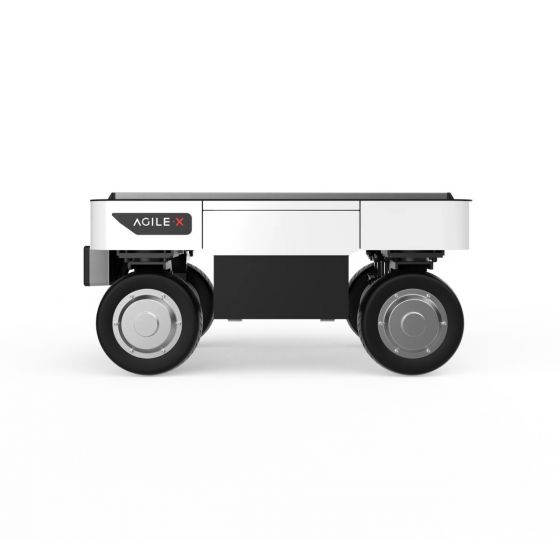
Ranger Mini 3.0 is designed specifically for industrial applications. This revolutionary mobile robot introduces innovative features to enhance its performance. Industrial mobile robot (RANGER MINI 3)
Introduction / Overview
AgileX RANGER MINI 3 (often referred to as Ranger Mini 3.0) is a compact, omnidirectional unmanned ground vehicle (UGV) / mobile robot base designed for industrial and research applications. It belongs to AgileX Robotics’ Ranger family and is positioned as a small, rugged platform intended for indoor–outdoor deployment, payload carrying, and secondary development through standard control interfaces and software resources. The platform is commonly used as a “robot chassis” for building autonomous or teleoperated systems such as inspection robots, sensor carriers, campus delivery prototypes, or mobile manipulation research platforms.
A defining characteristic of the Ranger Mini 3 class is its multi-modal mobility: it is designed to move in multiple directions and rotate in place, supporting tight maneuvering in confined spaces while maintaining all-terrain capability via independent suspension.
Design and Features
Chassis and mechanical layout
Ranger Mini 3.0 is built around a low-profile rectangular chassis intended to accept payloads and integration hardware. The platform is described as a small omnidirectional mobile robot with a focus on industrial uptime and field robustness.
Key mechanical features commonly cited include:
Four-wheel independent suspension, used to improve passability, stability under load, and off-road handling.
Four-wheel steering / multi-mode motion, enabling lateral movement, in-place rotation, and other steering behaviors depending on control mode and configuration.
A mounting-oriented frame concept, including aluminum T-slot rails intended for attaching sensors, compute boxes, payload frames, or research fixtures.
Mobility modes
Documentation and reseller descriptions characterize Ranger Mini 3.0 as supporting multiple movement modes, including spin-in-place behavior (0 mm turning radius in spin mode is listed in the user manual) and an Ackermann-style turning mode with a larger turning radius value listed separately.
Battery handling and maintainability
A frequently emphasized feature is hot-swapping / hot-swappable battery support, intended to reduce downtime for continuous operation scenarios.
Technology and Specifications
Note: Published specifications may differ slightly by vendor listing, configuration, test conditions, or translation. The values below reflect commonly published figures from manufacturer and distributor materials.
Core published performance
Payload: often listed as 100 kg on manufacturer and RobotShop marketplace listings.
Runtime: commonly presented as 7–8 hours (varies by usage).
Top speed: manufacturer page lists 2.0 m/s (≈ 7.2 km/h), and the manual lists 7.2 km/h.
Climbing ability: 15° is commonly listed (manual notes 15° with a specified load condition).
Ground clearance: commonly listed as 105 mm.
Dimensions and mass
A detailed specification table for Ranger Mini 3.0 commonly lists:
Size: 720 × 500 × 345 mm
Weight: 75 kg
Power and drivetrain (typical published figures)
Battery: commonly described as 48V 24Ah (often referenced as lithium iron phosphate in some listings).
Charging time: often listed around 1.5 hours.
Motors (example from a published spec table): 350W × 4 drive motors and 100W × 4 steering motors are listed in one specification sheet.
Interfaces and development
Ranger Mini 3.0 is positioned as a platform for secondary development, emphasizing:
CAN bus communication interface (standard CAN interface is explicitly mentioned for development).
Availability of an open-source SDK and software resources, intended to accelerate integration and custom autonomy stacks.
Applications and Use Cases
Industrial inspection and monitoring
Because it is marketed for industrial deployment and payload transport, Ranger Mini 3.0 is commonly framed as a base for facility inspection, equipment monitoring, and data collection (e.g., mounting cameras, thermal sensors, gas sensors, or LiDAR). Its multi-directional movement and ability to rotate in place can be useful in narrow corridors, plant aisles, and constrained indoor environments, while independent suspension supports uneven outdoor surfaces.
Research, education, and robotics development
As a mobile robot chassis with CAN connectivity and published development resources, the platform is often used in ROS/ROS 2-style robotics workflows (navigation, SLAM, perception experiments), and as a carrier for custom compute hardware (x86 or embedded GPUs) and sensor suites. Vendor positioning frequently targets universities, labs, and prototyping teams that need a “ready chassis” rather than building a vehicle from scratch.
Security and patrol prototypes
Hot-swappable batteries and mobile payload support make Ranger Mini 3.0 a common candidate for patrol, site security, and after-hours monitoring prototypes, where long operating windows and rapid battery swaps can matter more than high speed.
Mobile manipulation and “robot-on-a-base” integration
With a payload-rated chassis and expansion rails, Ranger Mini 3.0 can serve as a base for robot arms, inspection masts, or specialized end-effectors, supporting early development of mobile manipulation concepts (e.g., moving between workstations and performing simple interaction tasks).
Advantages / Benefits
Omnidirectional maneuverability in compact footprints
Compared with differential-drive platforms, Ranger Mini 3.0 is widely described as enabling multi-directional movement and in-place rotation, which can simplify docking, aisle navigation, and positioning tasks in tight environments.
Industrial-oriented uptime features
Battery hot-swapping is positioned as a practical feature for deployments where charging downtime is costly, while the overall product positioning emphasizes industrial use and “uptime.”
Secondary development path via CAN + SDK
A standard CAN interface and referenced open-source software resources are intended to reduce integration effort for autonomy stacks, teleoperation, and sensor fusion.
FAQ Section
What is the AgileX RANGER MINI 3?
AgileX RANGER MINI 3 (Ranger Mini 3.0) is a compact omnidirectional mobile robot base / UGV chassis designed for industrial deployment and robotics development, featuring independent suspension, CAN connectivity, and hot-swappable battery support.
How does the AgileX RANGER MINI 3 work?
It functions as a modular robot chassis: users mount sensors, compute hardware, and payload structures onto the base, then control motion via remote/command modes and integrate autonomy through development interfaces such as CAN and supporting software resources.
Why is the AgileX RANGER MINI 3 important?
It provides an off-the-shelf mobility platform that reduces the time and engineering cost needed to build an indoor–outdoor robot, while offering multi-directional maneuvering, payload capacity, and design features (like hot-swappable batteries) aimed at longer operational windows.
What are the benefits of the AgileX RANGER MINI 3?
Commonly cited benefits include omnidirectional mobility, independent suspension for uneven terrain, hot-swappable batteries for reduced downtime, and development-friendly expansion via CAN and open-source software resources.
Summary
AgileX RANGER MINI 3 (Ranger Mini 3.0) is a compact, omnidirectional industrial mobile robot base designed for secondary development and deployment across indoor and outdoor environments. With published emphasis on independent suspension, CAN-based integration, payload handling, and hot-swappable battery workflows, it is widely positioned as a practical UGV chassis for inspection, research, and prototyping where maneuverability and uptime matter.