Deep Robotics LYNX S10 Wheeled Quadruped Robot Dog
In stock
- BRAND:
- DEEP ROBOTICS
- PART #:
- LYNX S10
- ORIGIN:
- China
- AVAILABILITY:
- SUBJECT TO AVAILABILITY
- SKU:
- Deep-Robotics-LYNX-S10
Deep Robotics Lynx S10
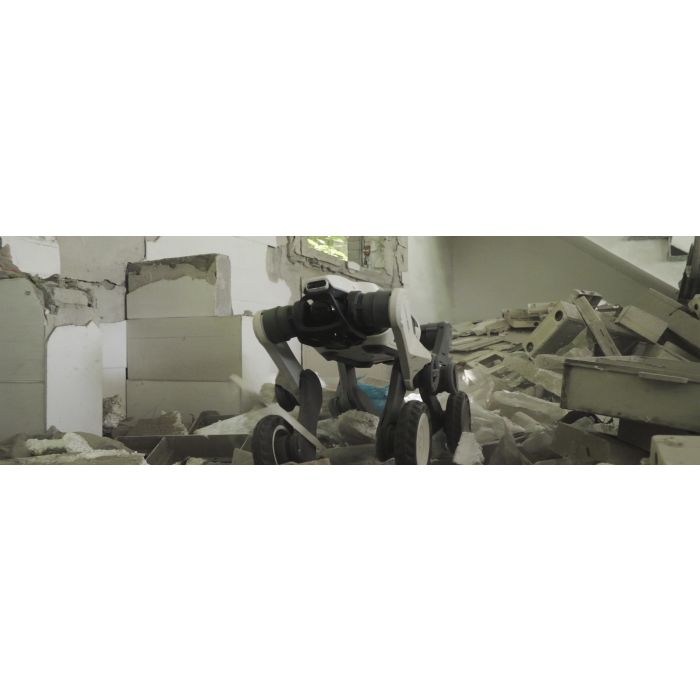
The industrial quadruped grew up assuming a van, a crew and a loading ramp. The Deep Robotics Lynx S10 assumes one person and a car boot. Launched on 22 May 2026 as the compact member of the Hangzhou company's Lynx wheeled-legged family, the S10 packs the category's full trick set — wheels for speed, legs for terrain, autonomy for the mission — into a body under 20 kilograms with the battery fitted, light enough for a single operator to carry to the site, set down and deploy in minutes. Its four limbs each end in a powered wheel: on smooth ground it rolls at up to 8 metres per second — roughly 29 kilometres per hour — while on debris, stairs and rubble it walks, clearing obstacles up to 50 centimetres; its sixteen high-precision joints let it fold and twist into gaps and narrow tunnels that exclude larger machines, and even rise into a bipedal stance where extra height or a tighter footprint is needed. Around that agility sits industry-grade hardening — IP66 protection against rain and dust, operation from minus 20 to 55 degrees Celsius — and genuine autonomy: dual front-and-rear LiDAR with a four-camera 360-degree perception system for self-built maps, autonomous path planning and obstacle avoidance, more than three hours of runtime, and self-directed return to a charging dock for continuous, unattended mission cycles. Its credentials in extreme conditions are not theoretical: a modified S10 prototype, fitted with bear-paw feet and crampons, became the first quadruped robot ever to step onto the ice floes of the Arctic Ocean.
The Deep Robotics Lynx S10 is available for purchase internationally through this page, with delivery, customs clearance and after-sales support arranged for buyers across Europe, the Americas, the Middle East, Asia-Pacific and worldwide.
Background
Deep Robotics and the Lynx line
DEEP Robotics of Hangzhou built its name where legged robots earn it hardest: substations, tunnels and industrial estates, where its X-series quadrupeds established the company as a leader in embodied AI for real infrastructure work. The Lynx family added the wheeled-legged formula — limbs that roll when the ground permits and step when it doesn't — and its larger M20 proved the concept at industrial payload scale. The S10 completes the range downward, answering the requests that heavy platforms cannot: sites reached on foot, confined interiors, rapid-response missions where the robot must arrive as luggage, and budgets that previously excluded the category. Deep Robotics positions it plainly as a benchmark for the small wheeled-legged segment — stronger than machines at its price, priced below machines at its strength.
Tested where nothing else has walked
The Arctic expedition tells buyers more than a datasheet can. Deployed from a research vessel onto polar sea ice — terrain of slick low-friction surfaces, hidden melt pools capable of swallowing a machine, and slush that mixes ice and water — the S10 prototype crawled, walked and glided through conditions that humans approach with extreme caution, completing its mission and logging a world first for quadruped robots. The production machine inherits that engineering: the same joint precision, weatherproofing and terrain-adaptive control, rated for rain, dust, frozen warehouses and furnace rooms alike. For inspection and rescue operators, the message is direct — the S10's operating envelope was proven at the planet's edge, not in a demonstration hall.
Technical Specifications
| Parameter | Deep Robotics Lynx S10 |
|---|---|
| Type | industry-grade small wheeled-legged robot |
| Launched | 22 May 2026 |
| Weight | under 20 kg including battery; single-person deployable |
| Joints | 16 high-precision joints; wheel-tipped limbs |
| Locomotion | wheeled rolling on smooth ground, legged walking on rough terrain, bipedal stand-up mode for height and tight spaces |
| Maximum speed | 8 m/s (~29 km/h) on flat ground |
| Obstacle clearance | up to 50 cm |
| Protection | IP66 (rain and dust) |
| Operating temperature | −20 °C to 55 °C |
| Perception | dual LiDAR (front and rear) plus four ultra-wide-angle cameras for 360° coverage |
| Autonomy | self-built mapping, autonomous path planning and obstacle avoidance |
| Endurance | 3+ hours per charge; autonomous return-to-dock charging supported |
| Variants | Lynx S10 and S10 Pro, with dedicated autonomous charging dock for continuous operation |
| Proven | modified prototype became the first quadruped robot on Arctic Ocean ice floes |
Configuration details, payload figures and accessory options are confirmed against the datasheet at quotation.
What makes the S10 different from a robot dog?
Wheels — and what they buy. A walking quadruped spends most of its mission walking on ground that never needed legs, paying for versatility with speed and battery. The S10's wheel-tipped limbs let it commute at 8 metres per second across the smooth majority of any site and spend its legged agility only where terrain demands it — stairs, kerbs, rubble, 50-centimetre obstacles — before rolling on. The result is more site covered per charge, faster response when patrol becomes incident, and a machine that keeps pace with a vehicle on the road it shares. The second difference is scale as a feature: under 20 kilograms, the S10 is checked luggage rather than cargo, deployable by one responder at the top of a trail or the mouth of a tunnel, and able to fold itself through gaps that end the mission for anything larger — then stand up on two legs to see over what it cannot pass.
Who is the Lynx S10 for?
For power utilities and infrastructure operators running inspection rounds through substations, corridors and tunnels where compactness and weatherproofing decide feasibility; for security teams wanting fast, autonomous, dock-charged patrol across mixed indoor-outdoor estates, data centres and industrial parks; for emergency and search-and-rescue services needing a machine one responder can carry in, send into rubble and voids, and trust in rain, heat and cold; for universities and research programmes seeking an affordable, hardened wheeled-legged platform for locomotion, perception and autonomy work; and for exploration, filming and field-survey teams operating far from loading ramps. Operators needing heavier payload capacity in the same formula will find the larger Lynx M20 alongside it in the Deep Robotics range.
What is the Deep Robotics Lynx S10 used for?
- Power and infrastructure inspection: autonomous rounds through substations, plants and utility tunnels in all weather.
- Security patrol: fast, self-charging perimeter and estate patrol with 360-degree perception, day and night cycles.
- Emergency search and rescue: single-person deployment into rubble, confined voids and disaster terrain.
- Reconnaissance: rapid autonomous survey of hazardous or inaccessible zones ahead of human entry.
- Education and research: wheeled-legged locomotion, autonomy and perception development on an industry-grade platform.
- Outdoor exploration and field work: portable all-terrain data collection from trails to polar-grade environments.
Pricing and Availability
The Deep Robotics Lynx S10 is available for purchase and international delivery through this page, from single units for inspection teams and laboratories to fleet deployments with autonomous charging docks for continuous patrol operations, with the S10 Pro variant and accessories quoted alongside. Deep Robotics positions the S10 as the value benchmark of its segment, and price and cost depend on variant, configuration, dock and accessory selection, training scope and quantity, so buyers should request a current quotation for their application; delivery, customs clearance and after-sales support are arranged worldwide. Purchase enquiries, datasheets and availability details for the Lynx S10 are available on this page.
Frequently Asked Questions
What is the Deep Robotics Lynx S10?
An industry-grade small wheeled-legged robot from DEEP Robotics of Hangzhou, launched in May 2026: a sub-20-kilogram machine that rolls on wheel-tipped limbs at up to 8 metres per second, walks over rough terrain and stairs, and operates autonomously for inspection, patrol, search-and-rescue, research and exploration.
How fast and how capable is it?
Up to 8 metres per second — roughly 29 kilometres per hour — on flat ground, with obstacle clearance to 50 centimetres, sixteen high-precision joints that fold it into tight spaces, and a bipedal stand-up mode for extra height; IP66 protection and a minus-20-to-55-degree operating range cover rain, dust, frozen sites and furnace rooms.
Can one person really deploy it?
Yes — that is its design brief: under 20 kilograms with the battery fitted, it travels as portable equipment, is carried to the site by a single operator, and is working within minutes.
How autonomous is it?
Substantially: dual front-and-rear LiDAR and four ultra-wide cameras give 360-degree perception; the robot builds its own maps, plans paths and avoids obstacles without operator input, runs more than three hours per charge, and returns itself to its dock — enabling continuous, unattended patrol cycles, particularly in the S10 Pro configuration.
Has it been proven in extreme conditions?
Emphatically — a modified S10 prototype fitted with bear-paw feet and crampons became the first quadruped robot to step onto Arctic Ocean ice floes, crossing slick ice, hidden melt pools and ice-water slush on a polar research expedition.
How does it compare with the Lynx M20?
The M20 is the family's larger industrial workhorse; the S10 is its rapid, portable sibling — the same wheeled-legged formula scaled for one-person deployment, confined spaces and lightweight operations, at a price positioned to open the category.
Where can I buy the Lynx S10 and what does it cost?
The Lynx S10 is available through this page, with delivery, customs clearance and after-sales support arranged for buyers worldwide. Because cost varies with variant, dock and accessory configuration and quantity, buyers should request an individual quotation. All purchasing details are available on this page.
Summary
The Lynx S10 shrinks the wheeled-legged category to the size of the missions that actually need it: one operator, one carry, one machine that rolls at 29 kilometres per hour where the ground is kind, walks where it isn't, folds through gaps, stands up on two legs to see, and shrugs off rain, dust, heat and Arctic ice alike. With dual-LiDAR autonomy, three-plus-hour endurance and self-charging continuity, it patrols, inspects and searches without a crew — and with Deep Robotics pricing it as the segment's benchmark, it opens the category to buyers the industrial giants priced out. From substation rounds to rubble voids to the edge of the sea ice, the small machine with the full skill set is now taking orders — and this page is the starting point.