Unitree G1 Ultimate B Humanoid Robot with 3 Finger Hands with Tactile Sensor (G1EDU-U4)

The Unitree G1 EDU Ultimate B, formally designated G1 EDU U4 (model code G1EDU-U4), is an advanced research and education configuration within Unitree Robotics' G1 compact humanoid robot family. It features 43 total degrees of freedom and is equipped with two Dex3-1 force-controlled three-finger dexterous hands with integrated tactile sensor arrays — the defining hardware that separates the U4 from the preceding U3 (EDU Ultimate A), which uses the same Dex3-1 hands without tactile sensing.

In stock

BRAND:
UNITREE ROBOTICS
MODEL:
G1 EDU ULTIMATE B
PART #:
G1EDU-U4
ORIGIN:
China
Warranty:
18 MONTHS
AVAILABILITY:
USUALLY SHIPS IN 7-14 BUSINESS DAYS
SKU:
Unitree-G1-Edu-U4
C$95,376.22
C$90,600.39
Loading...

Unitree G1 Ultimate B Humanoid Robot with 3 Finger Hands with Tactile Sensor (G1EDU-U4)
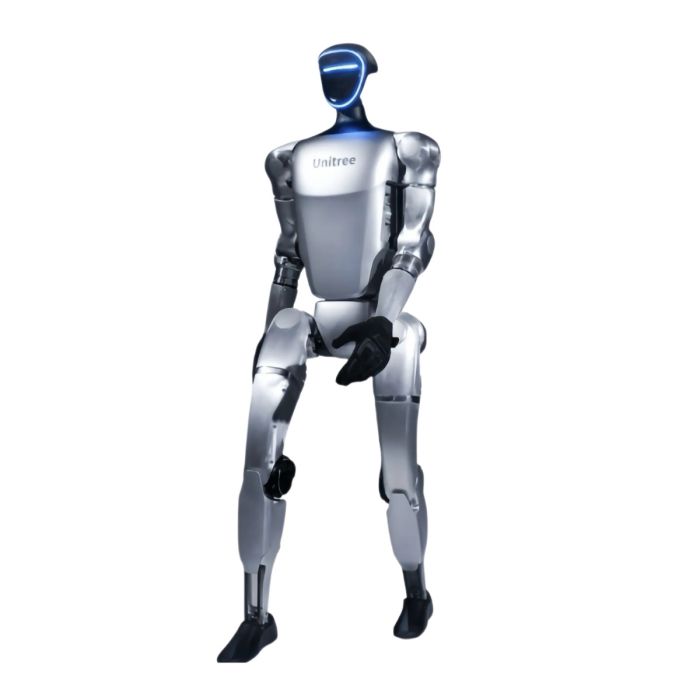
The G1 EDU Ultimate B (U4) is equipped with 2 Dex3-1 force-controlled 3-finger dexterous hands with tactile sensors. Each joint is monitored by a dual encoder, enhancing precision in movement tracking. A local air cooling system ensures optimal performance under load, supported by a robust 13-string lithium battery that powers the entire unit. The U4 is powered by the NVIDIA Jetson Orin NX 16GB (100 TOPS) AI compute module alongside an 8-core high-performance CPU, providing dual-tier computation for real-time robot control and neural network inference. Sensing includes a LIVOX MID-360 3D LiDAR, Intel RealSense D435i depth camera, WiFi 6 and Bluetooth 5.2 connectivity, and a 4-microphone array. The quick-release 9,000 mAh battery provides approximately two hours of operational runtime.

G1 Body Platform: 132 cm, 35 kg, Foldable

The G1 EDU Ultimate B uses the standard G1 body frame. The G1 EDU Ultimate B (U4) is a next-generation humanoid robot engineered for advanced research, intelligent automation, and high-precision manipulation. Featuring an impressive 43 degrees of freedom and dual Dex3-1 force-controlled dexterous hands with integrated tactile sensors, the U4 enables refined, human-like interaction and adaptive control across complex tasks.

Standing dimensions are 1320 x 450 x 200 mm with a folded configuration of 690 x 450 x 300 mm. Body mass is approximately 35 kilograms with battery installed. The foldable design enables transport in standard equipment cases — a practical feature for research teams that move platforms between laboratory spaces, conference venues, and demonstration sites.

The aluminum alloy structural frame with ABS/PC blend exterior panels provides industrial-grade durability while maintaining the compact form factor that distinguishes the G1 from full-size humanoid platforms. The full joint hollow design routes all power and communications internally, reducing external cable snag risk.

43 Degrees of Freedom: Complete Body Articulation

The Unitree G1 EDU Ultimate B (U4) Humanoid Robot is designed to unlock unlimited potential in sports and other applications, boasting extra-large joint movement angles across its 43 joints.

The 43-DOF total distributes across the full body:

Legs: Six degrees of freedom per leg (bilateral, 12 total) with extra-large joint ranges — hip pitch ±154°, hip roll -30° to +170°, hip yaw ±158°, knee 0° to 165°. These extended ranges are specifically highlighted by Unitree as enabling athletic dynamic behaviors beyond standard walking and running.

Arms: Seven degrees of freedom per arm (bilateral, 14 total) including wrist pitch ±92.5° and wrist yaw ±92.5° — the wrist DOF added in the EDU Ultimate tier enabling full hand orientation control for approaching objects from any direction.

Waist: Three degrees of freedom (yaw ±155°, plus pitch and roll for whole-body coordination) — enabling torso rotation, forward-backward lean, and lateral tilt for extended reach and whole-body balance during manipulation.

Dex3-1 Hands: Seven active degrees of freedom per hand (bilateral, 14 total) — thumb (3 DOF), index finger (2 DOF), middle finger (2 DOF) — reaching the 43-DOF total across the complete body-plus-hands system.

Dex3-1 Three-Finger Force-Controlled Hands with Tactile Sensors

The Dex3-1 is Unitree's proprietary three-finger dexterous hand, with the following kinematic distribution confirmed by Unitree's official product page: The thumb has 3 active degrees of freedom; the index finger has 2 active degrees of freedom; the middle finger has 2 active degrees of freedom. Dex3-1 can optionally be installed with tactile sensor arrays.

In the U4, both Dex3-1 hands are installed with tactile sensor arrays as standard — the "optional" designation in Unitree's documentation refers to the choice between the U3 (without tactile) and the U4 (with tactile).

The Dex3-1's three-finger layout provides the grasping configurations most relevant to industrial and research manipulation tasks:

Thumb-opposed grasps: The thumb's 3 DOF enables full opposition across the palm toward the index and middle fingers, supporting precision pinch grasps with the thumb and index, and tripod grasps with all three fingers.

Power grasps: With all three fingers closed, the Dex3-1 provides secure power grasps on cylindrical and spherical objects within its hand envelope.

Lateral key grip: The thumb can be positioned laterally (parallel to the index finger pad) for key grip and card grip configurations.

The tactile sensor arrays integrated into the Dex3-1 in the U4 configuration provide distributed contact pressure sensing across the finger surfaces, enabling the manipulation controller to receive contact force feedback beyond the joint-level torque estimation that the drive motors provide. This contact sensing is what enables the U4 to perform force-regulated manipulation — adjusting grip force based on actual contact pressure rather than estimated torque — for fragile object handling and slip detection.

Force-Position Hybrid Control: The Dex3-1 operates under force-position hybrid control — blending commanded finger position targets with contact force limits. This control mode enables the hand to form a grasp configuration (position control) while limiting the contact force to prevent crushing (force control), transitioning smoothly between position-dominant and force-dominant control as the manipulation task progresses.


Technology and Specifications

G1 EDU Ultimate B (U4) Full Specifications

Specification Value
Height ~132 cm (1320 mm)
Weight ~35 kg
Total DOF 43
Arm DOF 7 per arm (bilateral)
Leg DOF 6 per leg (bilateral)
Waist DOF 3
Hand Type Dex3-1 three-finger (7 DOF per hand, bilateral)
Hand DOF Distribution Thumb: 3 DOF; Index: 2 DOF; Middle: 2 DOF
Tactile Sensors Arrays integrated into both Dex3-1 hands
Joint Encoders Dual encoders per joint
Knee Joint Torque 120 N·m
Arm Payload ~3 kg
Main Compute 8-core high-performance CPU
AI Compute NVIDIA Jetson Orin NX 16GB (100 TOPS)
3D LiDAR LIVOX MID-360
Depth Camera Intel RealSense D435i
Battery 13-series 9,000 mAh lithium, quick-release
Battery Runtime ~2 hours
Thermal Management Local air cooling system
Connectivity WiFi 6, Bluetooth 5.2
Audio 4-microphone array, 5W stereo speaker
AI Framework UnifoLM + UnifoLM-VLA-0 (open-source, March 2026)
SDK Full: Python, C++, ROS 2
Secondary Development Fully supported
Confirmed Price (Top3DShop) $66,277
Delivery Time ~2 months
Warranty 12 months (24 months EU/UK at OpenELAB)

NVIDIA Jetson Orin NX 16GB and Dual-Compute Architecture

The U4's NVIDIA Jetson Orin NX 16GB provides 100 TOPS of GPU-accelerated AI compute specifically relevant for manipulation research with tactile sensing. Neural network-based tactile processing — using learned models to interpret the spatial pattern of tactile sensor readings for grasp quality assessment, object classification, or slip detection — requires the GPU acceleration that the Jetson Orin provides to run at control-loop frequencies.

The dual-compute architecture pairs the Jetson Orin with the 8-core CPU: the CPU handles real-time joint control, sensor fusion, and system management at low latency, while the Jetson Orin runs AI model inference without competing for CPU resources. This separation maintains the control loop timing needed for stable manipulation while enabling sophisticated on-device AI.

UnifoLM and the Research Software Stack

The G1 EDU Ultimate B (U4) runs Unitree's UnifoLM onboard — the multimodal AI model providing voice and image interaction. The March 2026 open-source release of UnifoLM-VLA-0 (built on Qwen2.5-VL-7B) provides a working manipulation policy baseline covering 12 task categories deployable on the U4, including tasks that benefit from the Dex3-1's tactile feedback for force-regulated grasping.

The development stack confirmed by BotInfo.ai applies directly: "Train policies in Isaac Sim or MuJoCo using the G1 URDF → apply domain randomization → export policy → deploy to Jetson Orin via unitree_sdk2 → iterate with real-world data collection via VR teleoperation for imitation learning refinement." With 30-plus papers published in 2025 using G1 EDU configurations across locomotion, manipulation, and HRI, the research community using this stack is large and growing, providing published baseline code, training recipes, and sim-to-real transfer approaches that U4 buyers can draw on.


Applications and Use Cases

Tactile Grasp Policy Learning

The U4's primary research advantage over the U3 is the tactile sensor arrays in the Dex3-1 hands — enabling research on manipulation policies that use contact sensor data as part of their observation space. Published research on tactile grasp policies consistently demonstrates that policies trained with tactile feedback generalize better across object variations, surface conditions, and grasp configurations than vision-only or kinematic-only policies. The U4 provides the hardware substrate for this research in the G1's compact, sub-$70,000 form factor.

Fragile and Deformable Object Manipulation

Handling fragile objects — pharmaceutical blister packs, glass containers, assembled electronics, delicate laboratory specimens — requires real-time contact force regulation that prevents exceeding the object's structural tolerance. The U4's Dex3-1 tactile arrays enable feedback-controlled grip force — adjusting finger closure force based on sensed contact pressure rather than commanded position. This contact-aware control is what enables stable grasping of objects that a position-controlled gripper would crush.

Haptics and Human-Robot Interaction Research

These sensors enable a higher level of precision in object handling, making this model ideal for cutting-edge research in haptics, human-robot interaction, and physical AI applications. Physical HRI research — studying how contact forces during robot-human touch affect interaction quality, safety, and trust — requires tactile sensing at the robot's hands to measure the forces experienced during physical contact with a human hand or body.

Haptic teleoperation research — where a human operator receives force feedback reflecting the robot's contact forces during remote operation — also requires the U4's tactile sensing capability to provide the contact information needed for force feedback generation.

Slip Detection and Reactive Grasping

The tactile sensor arrays enable detection of object sliding onset — the early change in contact pressure distribution that precedes a full drop event — before position-based sensing detects movement. This slip detection capability enables reactive grasp stabilization: when the sensor pattern indicates slip beginning, the controller increases finger closure force to re-stabilize the grasp before the object moves detectably. For robotic systems that must reliably hold and transport objects over unpredictable terrain or during dynamic whole-body motion, this pre-slip detection substantially improves grasp reliability.

Medical Robotics Prototyping

The G1 family has demonstrated a 90 percent success rate in academic medical task research. For medical robotics research studies involving instrument handling, medication preparation, or patient care assistance, the U4's tactile sensing enables the force regulation that medical objects (fragile containers, surgical instruments) and patient contact require. Roboworks notes that the G1 Ultimate has "found meaningful positions in many applications in industry, healthcare, and entertainment" — with the tactile hands being the specific feature that enables healthcare applications requiring delicate force control.


Comparison: U4 vs. U3 vs. U5 in the G1 EDU Ultimate Tier

Feature EDU Ultimate A (U3) EDU Ultimate B (U4) EDU Ultimate C (U5)
Hand Type Dex3-1 three-finger Dex3-1 three-finger Inspire five-finger
Tactile Sensors No Yes No
Five-Finger Dexterity No No Yes
Total DOF 43 43 41
AI Compute Jetson Orin 100 TOPS Jetson Orin 100 TOPS Jetson Orin 100 TOPS
Dual Encoders Yes Yes Yes
Confirmed Price $64,292 $66,277 $66,277
Best For Three-finger manipulation, max DOF Three-finger manipulation + tactile research Five-finger kinematics

Frequently Asked Questions (FAQ)

What is the Unitree G1 EDU Ultimate B (U4)? The Unitree G1 EDU Ultimate B (G1EDU-U4) is an advanced research and education configuration of the Unitree G1 humanoid robot, featuring 43 total degrees of freedom and dual Dex3-1 force-controlled three-finger dexterous hands with integrated tactile sensor arrays. It includes NVIDIA Jetson Orin NX 16GB (100 TOPS) AI compute, an 8-core CPU, LIVOX MID-360 3D LiDAR, Intel RealSense D435i depth camera, dual encoders per joint, local air cooling, a 9,000 mAh quick-release battery, and full secondary development support through Python, C++, and ROS 2 SDK. It is priced at approximately $66,277 and ships in approximately two months through authorized distributors globally.

What is the Dex3-1 three-finger hand, and how does the U4's tactile version differ from the U3? The Dex3-1 is Unitree's proprietary three-finger force-controlled hand with 7 active degrees of freedom (thumb: 3 DOF, index: 2 DOF, middle: 2 DOF). The G1 EDU Ultimate A (U3) includes Dex3-1 hands without tactile sensors, enabling three-finger kinematic manipulation with force-position hybrid control but no distributed contact sensing. The G1 EDU Ultimate B (U4) adds tactile sensor arrays to the same Dex3-1 hands, enabling distributed contact pressure sensing for grasp quality assessment, slip detection, and force-regulated grasping of fragile objects — research capabilities that the U3 cannot provide.

What research is the G1 EDU Ultimate B (U4) specifically designed for? The U4 is optimized for tactile grasp policy learning, slip detection and reactive grasping research, fragile object manipulation with force regulation, haptics and physical human-robot interaction research, medical robotics prototyping involving delicate object handling, and manipulation research where distributed contact sensing is required to develop reliable grasping policies. The tactile sensor arrays in the Dex3-1 hands are the hardware enabling all these applications — research programs that do not require contact sensing can use the lower-priced U3 instead.

How much does the Unitree G1 EDU Ultimate B (U4) cost, and where can I buy it? The G1 EDU Ultimate B (U4) is priced at approximately $66,277 (confirmed by Top3DShop). It is available through RobotShop (robotshop.com, global), OpenELAB Technology (openelab.io, 12-month warranty, 24-month EU/UK), RoboStore (robostore.com), Top3DShop (buy or lease), Futurology.tech, BotInfo.ai (North American institutional procurement with NET 30/60 and grant documentation), and Roboworks (roboworks.net, EU/UK). Delivery time is approximately two months. EU and UK buyers should request import-inclusive pricing from regional distributors.

How does the U4 compare to the U5 (EDU Ultimate C) at the same price? The U4 and U5 are both priced at approximately $66,277 but provide different research capabilities. The U4 (EDU Ultimate B) has 43 DOF, Dex3-1 three-finger hands with tactile sensors, and no five-finger capability. The U5 (EDU Ultimate C) has 41 DOF, Inspire five-finger hands without tactile sensors, and no distributed contact sensing. The U4 is the right choice for research requiring tactile contact sensing (fragile grasping, slip detection, haptics); the U5 is the right choice for research requiring the full five-finger human grasp taxonomy without contact sensing. Both have Jetson Orin 100 TOPS, dual encoders, and the same full SDK.


Summary

The Unitree G1 EDU Ultimate B (G1EDU-U4) occupies the tactile-sensing tier within the G1 EDU Ultimate lineup — adding distributed contact pressure sensing to the Dex3-1 three-finger hands at a $1,985 premium over the kinematic-only U3, enabling the full research spectrum of tactile manipulation science in a compact, proven, and globally available bipedal humanoid platform. With 43 total degrees of freedom, NVIDIA Jetson Orin 100 TOPS compute, dual encoders per joint, 120 N·m knee torque, the UnifoLM-VLA-0 open-source manipulation baseline, and the G1's established 5,500-plus unit production track record, the U4 delivers the research infrastructure that tactile manipulation, haptics, fragile object handling, and physical HRI research programs require — at a price point of $66,277 that no competing platform at comparable capability can currently match.

Specifications

Degrees of Freedom
m/s
Max Speed
up to hours
Runtime

General

BRAND UNITREE ROBOTICS
MODEL G1 EDU ULTIMATE B
ROBOT TYPE HUMANOID
ROBOT USE EDUCATION, RESEARCH

Dimensions

HEIGHT 132.0 cm
WIDTH 45.0 cm
DEPTH 20.0 cm
WEIGHT APPROX. 35 kg WITH BATTERY
FOREARM + UPPER ARM LENGTH 45.0 cm
CALF + THIGH LENGTH 60.0 cm

Degrees Of Freedom

TOTAL DOF 42 DEGREES OF FREEDOM
HEAD / NECK DOF N/A
ARM DOF 5 DEGREES OF FREEDOM
WRIST DOF 3 DEGREES OF FREEDOM
HAND DOF 7 DEGREES OF FREEDOM
WAIST DOF 3 DEGREES OF FREEDOM
LEG DOF 6 DEGREES OF FREEDOM

Robotics

DEXTEROUS HANDS DEX3 WITH TACTILE SENSORS
MAXIMUM SPEED 2 METERS / SECOND
PEAK KNEE TORQUE 120 N.m
CONNECTIVITY BLUETOOTH 5.2, WiFi 6
MAXIMUM ARM PAYLOAD ~ 3 KG
COOLING SYSTEM LOCAL AIR COOLING
MATERIALS ALUMINIUM ALLOY, HIGH-STRENGTH ENGINEERING PLASTICS

Computing

COMPUTING POWER 8-CORE HIGH-PERFORMANCE CPU
SECONDARY COMPUTING POWER NVIDIA JETSON ORIN NX 16GB
GPU 100 TOPS
SECONDARY DEVELOPMENT SUPPORTED
OTA UPDATES Yes

Perception System

3D LiDAR LIVOX MID-360
DEPTH CAMERA INTEL REALSENSE D435i

Battery + Power

RUNTIME UP TO 2 HOURS
BATTERY CAPACITY 9000 mAh
POWER SUPPLY 13 STRING LITHIUM BATTERY

Feature

Equipped with all the functions of G1-Edu standard version
Upgraded from 1 to 3 degrees of freedom in the waist.
Single arm freedom upgraded from 5 to 7, both arms upgraded.
Up to 29 DOF for whole robot

Product Questions

Your Question:
Write a Review
You're reviewing: Unitree G1 Ultimate B Humanoid Robot with 3 Finger Hands with Tactile Sensor (G1EDU-U4)
loader
Loading...

You submitted your review for moderation.