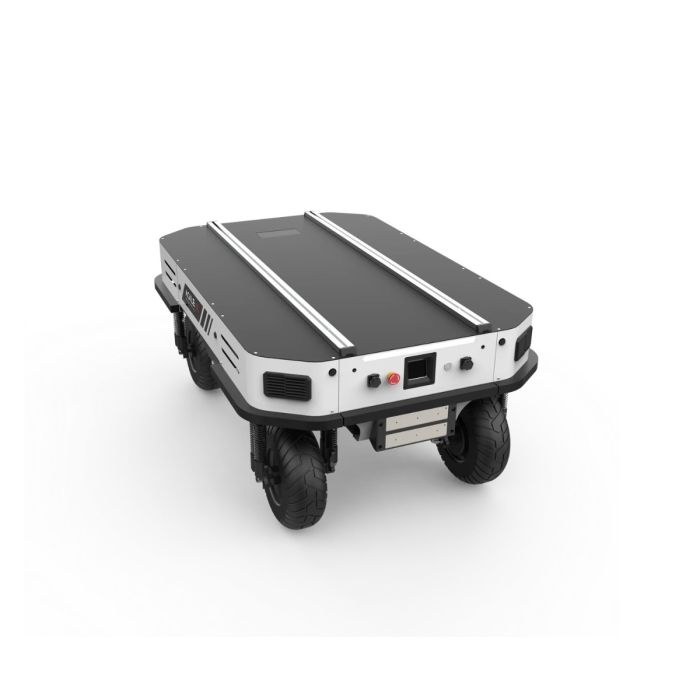
Agilex RANGER (RANGER)
In stock
- BRAND:
- AGILEX
- PART #:
- RANGER
- ORIGIN:
- China
- AVAILABILITY:
- SUBJECT TO AVAILABILITY
- SKU:
- AgileX-RANGER
Agilex RANGER (RANGER)
Agilex RANGER (RANGER)
On official product materials, the RANGER is described as an “omnidirectional” robot intended to navigate dynamic environments while carrying substantial loads, with a headline runtime figure and published top-speed specification.
RANGER-class mobile bases are commonly used in robotics R&D because they allow teams to focus on perception, navigation, and application-layer development (inspection, logistics, security) without building the drivetrain and low-level control stack from scratch. The RANGER manual also frames the platform as a programmable chassis with modular design, intended to be paired with sensors such as LiDAR, GNSS, stereo cameras, and IMUs, as well as end-effectors like manipulators, depending on the mission.
Design and Features
Modular chassis and payload focus
AgileX emphasizes modular design for customization, including mounting flexibility (e.g., aluminum T-slot rails) and a payload-oriented structure intended for building application-specific robots. Official product text highlights payload capability and “free module combinations” to tailor configurations.
Published payload numbers can vary by source and configuration: the official page presents a prominent payload figure while also stating the chassis “supports hefty 150 kg payloads” in its feature description. The user manual lists a loading capacity of 150 kg.
Locomotion and steering architecture
The RANGER is characterized by a four-wheel, four-steering layout and an independent suspension system intended to improve passability and stability on uneven surfaces. AgileX’s product description similarly highlights “Four-Wheel Independent Suspension” and frames it as beneficial for terrain handling and safety on slopes.
In the manual’s comparative framing, the RANGER is positioned against:
-
Four-wheel differential chassis (often simpler, but with higher tire wear in some turning behaviors and less flexibility),
-
Ackermann steering chassis (efficient for forward motion but less capable of in-place turning),
while noting that RANGER aims to combine advantages such as in-situ steering and broader application coverage across varied terrain.
Power system and serviceability
AgileX markets a hot-swap modular battery system with fast charging and hot swapping to reduce downtime. In the manual, the battery system is described as lithium iron phosphate (LiFePO₄) with a 48V 24Ah single-battery specification and support for up to four batteries, which aligns with the idea that runtime depends heavily on battery count, payload, duty cycle, and terrain.
Technology and Specifications
Core mechanical and electrical specifications
The RANGER manual lists key physical and drivetrain parameters, including:
-
Dimensions (L×W×H): 1228 × 876 × 475 mm
-
Wheelbase: 560 mm; Axle track: 890 mm
-
Curb weight: 100 kg (listed as curb weight in the table)
-
Motors: 48V brushless geared drive motors, 600W × 4
-
Drive motor torque: 22 N·m × 4; Steering torque: 35 N·m × 4
-
Steering: four wheels four steering
-
Suspension: independent suspension
-
Battery: LiFePO₄, 48V 24Ah (single battery); supports up to four batteries
-
Maximum battery life: 2–8 h (usage-dependent)
Speed, grades, and obstacles
Speed figures differ across published materials. The official product page shows 2.6 m/s as the speed figure.The manual’s parameter table lists maximum speed: 2.6 km/h. In practice, such discrepancies can occur due to model revisions, firmware limits, unit labeling, or regional documentation differences. For procurement or technical validation, it is best to verify the exact spec sheet tied to the specific RANGER version and controller firmware in use.
The manual also lists:
-
Maximum gradeability: 10°
-
Maximum obstacle crossing: 100 mm for vertical obstacles under full load (as stated in the table)
-
Loading capacity: 150 kg
Environmental and protection characteristics
The manual provides operating guidance including:
-
Operating temperature: -10°C to 40°C
-
Ingress protection: IP55 (water/dust protection level as stated)
-
Recommended altitude: not exceeding 1000 m
Interfaces and software enablement (CAN, SDK, ROS)
RANGER is positioned as a development platform with a CAN bus interface and open development resources. AgileX’s product page states CAN bus protocol support, plus “open-source SDK and software resources.”
The user manual goes further by documenting a typical development setup (Ubuntu + ROS) and referencing AgileX repositories used for chassis control and ROS integration, including:
-
ugv_sdk and ranger_ros repositories (cloned in a ROS workspace workflow)
It also describes ROS launch examples for bringing up the base and keyboard teleoperation.
Applications and Use Cases
Field robotics and inspection
RANGER-style UGV platforms are frequently used for unmanned inspection in industrial sites, energy infrastructure corridors, and large facilities, where the ability to mount LiDAR, GNSS, cameras, and edge computing enables mapping and autonomous patrol routines. The manual explicitly lists inspection-oriented and security-oriented application domains and highlights compatibility with common sensor payloads.
Security, patrol, and campus operations
For security and patrol use, a rugged mobile base can support multi-sensor perception (visible + thermal cameras, LiDAR) and remote operation via teleop interfaces. The manual references “intelligent security” and logistics among the application categories.
Research, autonomy development, and education
RANGER can serve as a development chassis for autonomy stacks (e.g., mapping, localization, planning) where researchers integrate navigation sensors and iterate on software using ROS tooling. The manual’s ROS workflow and CAN-based control orientation aligns with this role.
Logistics and material carrying prototypes
Payload capacity is a core positioning point for RANGER, making it relevant for internal logistics prototypes—carrying bins, tools, or equipment—particularly in controlled outdoor environments and warehouses. AgileX’s official page highlights both payload and runtime as headline product attributes.
Advantages / Benefits
Why teams choose a chassis like RANGER
-
Development acceleration: A ready-to-integrate drivetrain and chassis reduces mechanical and embedded workload, letting teams focus on autonomy and application development.
-
Mobility flexibility: Four-wheel steering and omnidirectional motion concepts can simplify navigation in constrained spaces compared to purely Ackermann systems.
-
Payload and modularity: Published payload capability (commonly cited up to 150 kg in official text/manual) supports heavier sensors, compute, and application payloads.
-
Ecosystem integration: CAN interface plus referenced ROS packages and SDK repositories can shorten bring-up time for robotics teams.
Practical constraints to consider
As with most UGV bases, real-world performance depends on terrain, payload distribution, tire choice, and duty cycle. Runtime and speed should be validated under target operating conditions, especially given the speed-spec discrepancy across published sources.
FAQ
What is the AgileX RANGER robot?
AgileX RANGER is a 4WD omnidirectional mobile robot chassis (UGV base) designed to carry payloads and serve as a development platform for inspection, security, logistics, and robotics research applications.
How does the RANGER robot work?
RANGER combines a powered drivetrain with four-wheel steering and independent suspension, and it exposes control/status through interfaces such as CAN bus for secondary development. In many deployments, developers add sensors (LiDAR, cameras, GNSS/IMU) and run autonomy software (often via ROS).
Why is the RANGER platform important for robotics development?
A standardized UGV chassis can significantly reduce time-to-prototype. RANGER is designed to support modular expansion, payload mounting, and software integration (including referenced SDK/ROS repositories), enabling teams to focus on autonomy and application logic rather than drivetrain engineering.
What are the benefits of the RANGER robot chassis?
Commonly cited benefits include modularity, payload capability (often referenced up to 150 kg), multi-mode maneuverability with four-wheel steering, and developer-oriented interfaces/software resources (CAN + SDK/ROS tooling).
What is the payload capacity of AgileX RANGER?
Published specs commonly reference up to 150 kg payload capacity in both the official feature text and the user manual table (exact payload may vary by configuration and safety margin). port?
The user manual states an operating temperature range of -10°C to 40°C and indicates IP55 dust/water protection, with a recommended operating altitude not exceeding 1000 m.
Summary
AgileX RANGER is a modular 4WD omnidirectional UGV chassis designed for real-world robotics deployment and research, combining payload-oriented mechanical design, four-wheel steering, developer-focused interfaces (CAN), and commonly used ROS/SDK workflows. Its flexibility makes it relevant for inspection, security, and logistics prototypes, while published specifications (payload, runtime, speed) should be verified against the exact configuration and documentation version used for a given project.