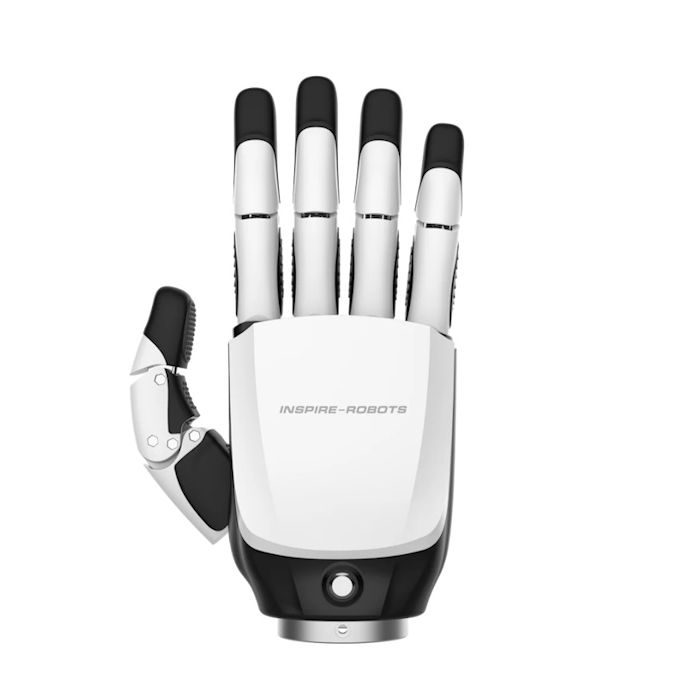
Inspire Robots Dexterous Robot Hand (RH56DFX)
In stock
- BRAND:
- INSPIRE ROBOTS
- PART #:
- RH56DFX
- ORIGIN:
- China
- AVAILABILITY:
- SUBJECT TO AVAILABILITY
- SKU:
- Inspire-RH56DFX
Inspire Robots Dexterous Robot Hand (RH56DFX)
RH56DFX Dexterous Robot Hand (RH56DFX)
Positioned within a broader class of “anthropomorphic” hands, the RH56DFX aims to combine compact size, multi-joint finger articulation, and sensor feedback so that robotic arms, humanoid platforms, and test benches can perform a wider range of manipulation tasks—such as pinch grasps, power grasps, and basic in-hand pose adjustments—than would be possible with parallel-jaw grippers.
In common deployments, the RH56DFX is used as a robot hand for manipulation R&D, including dexterous grasp planning, imitation learning, teleoperation experiments, and end-to-end learning pipelines where a hand’s joint states and force feedback become part of the control loop. Product listings and selection materials typically describe the RH56DFX as a “strong grip” option in its family, emphasizing load-handling over extreme speed.
Design and Features
Anthropomorphic form factor
The RH56DFX follows a human-like layout with a palm and five fingers. In typical presentations, it is offered in left- and right-hand variants, and some resellers also list “hand + wrist” configurations for easier mounting or added articulation at the wrist interface.
Finger joint architecture
Across vendor descriptions, the RH56DFX is commonly characterized as having multiple joints per finger (often summarized as “12 joints”) and a smaller number of actively controlled degrees of freedom (DoF) (often summarized as “6 DoF”).
In practice, this usually means the hand includes many mechanical joints, while a subset is directly actuated and/or coupled through tendon-like or linkage mechanisms (a common approach in compact dexterous hands). Exact mappings (which joints are independently actuated versus mechanically coupled) depend on the specific variant and controller configuration.
Integrated sensing and feedback
Marketing and selection documentation for the RH56 family frequently highlights force sensing / force feedback as a core capability, enabling safer contact and more controlled grasping compared with purely position-driven grippers.
Some reseller pages also describe tactile sensing availability at the family level (e.g., tactile variants), while the RH56DFX is generally framed as a force-feedback “gripper” model rather than the most tactile-focused configuration.
Technology and Specifications
Degrees of freedom and joints
Commonly stated headline figures include:
-
6 DoF (as a product-family specification for RH56DFX)
-
12 joints (often used to describe the finger/palm joint structure)
Positioning accuracy / repeatability
At least one component-focused reseller specifies a repeat positioning accuracy on the order of ±0.20 mm for the hand.
Payload and grip capability
Selection guidance materials for the RH56 series describe the RH56DFX as suitable for higher-load gripping, including an example of lifting a 5 kg bucket (presented as a representative capability/use case).
Some product listings also state grip force figures (e.g., ~30 N) for the RH56DFX.
Interfaces and software integration
Reseller and marketplace descriptions commonly mention:
-
RS485 as a communication interface (typical in industrial embedded devices)
-
ROS compatibility and/or availability of ROS plug-ins for integration into robotics stacks
Mass and handling
Weight figures can differ depending on whether the value refers to the hand alone versus packaged shipping weight. For example, one listing cites ~540 g for the hand, while another lists ~1.0 kg, likely reflecting packaged weight or a different kit configuration.
Applications and Use Cases
Robotics research and dexterous manipulation
The RH56DFX is frequently positioned for manipulation research where multiple grasp types and contact-rich interaction are essential. Typical projects include:
-
Learning-based grasp synthesis (data collection, imitation learning, reinforcement learning)
-
Contact-aware control using force feedback
-
Human-in-the-loop teleoperation experiments (especially when paired with motion capture or VR controllers)
Humanoid robotics and mobile manipulation
Humanoid and service-robot platforms benefit from a dexterous hand when tasks involve varied object geometries (tools, handles, bottles, packaging). RH56DFX-style hands are often used to prototype “general-purpose” manipulation without designing task-specific grippers for each object class.
Industrial prototyping and applied automation
While many industrial deployments still rely on robust parallel grippers, dexterous hands are increasingly used in:
-
Prototype workcells for mixed-object handling
-
“Last-meter” manipulation around fixtures where a single-purpose gripper would be too limiting
-
R&D trials for assembly-like operations where precision contact matters
Prosthetics and human-interaction research
Some distributors describe RH56-series hands in contexts related to prosthetics research or human-robot interaction, largely due to their human-like geometry and sensor feedback potential.
Advantages / Benefits
Greater grasp variety than standard grippers
A multi-finger hand can perform pinch, tripod, and power grasps, improving the ability to handle objects with irregular shapes or requiring nuanced contact points.
Force-feedback–enabled interaction
Integrated force sensing/feedback can make contact-rich tasks more controllable and can reduce the risk of crushing fragile items compared to purely position-based actuation.
ROS-friendly integration
ROS compatibility and plug-in availability reduce integration time for research labs and robotics teams that already build tooling around ROS pipelines.
Compact, modular deployment
Left/right variants and wrist options sold by some resellers can simplify mechanical integration across different robot arms and humanoid platforms.
FAQ Section
What is the Inspire Robots RH56DFX?
The RH56DFX is a five-finger dexterous robotic hand designed to mount on robotic arms or humanoid platforms, providing multi-joint grasping and sensor feedback beyond what typical two-jaw grippers can achieve.
How does the RH56DFX work?
The RH56DFX uses multiple finger joints (often summarized as 12 joints) driven through a smaller set of controlled degrees of freedom (often summarized as 6 DoF). It combines position control with force/feedback sensing so the hand can grasp and interact with objects more safely and consistently.
Why is a dexterous robot hand like RH56DFX important?
Dexterous hands are important because many real-world tasks—tool handling, mixed-object picking, and contact-rich manipulation—benefit from multiple grasp types and controlled contact forces. Force feedback can improve reliability and reduce damage when handling fragile or variable objects.
What are the benefits of the RH56DFX compared with a standard gripper?
Compared with a parallel-jaw gripper, the RH56DFX can provide more grasp variety, more human-like contact geometry, and force-feedback–assisted interaction, making it useful for research, humanoid robotics, and mixed-object manipulation tasks.
Summary
The RH56DFX dexterous robotic hand is an anthropomorphic, five-finger end-effector positioned for manipulation tasks that demand more capability than conventional grippers. With a multi-joint architecture (often summarized as 12 joints and 6 controlled DoF), force-feedback–oriented sensing, and commonly advertised ROS-friendly integration, it is widely used in research and applied robotics environments where grasp diversity and controlled contact are central requirements.