
PUDU Robotics D9 Humanoid Robot
In stock
- BRAND:
- PUDU ROBOTICS
- PART #:
- D9
- ORIGIN:
- China
- AVAILABILITY:
- SUBJECT TO AVAILABILITY
- SKU:
- Pudu-Robotics-D9
Pudu Robotics D9 (D9)
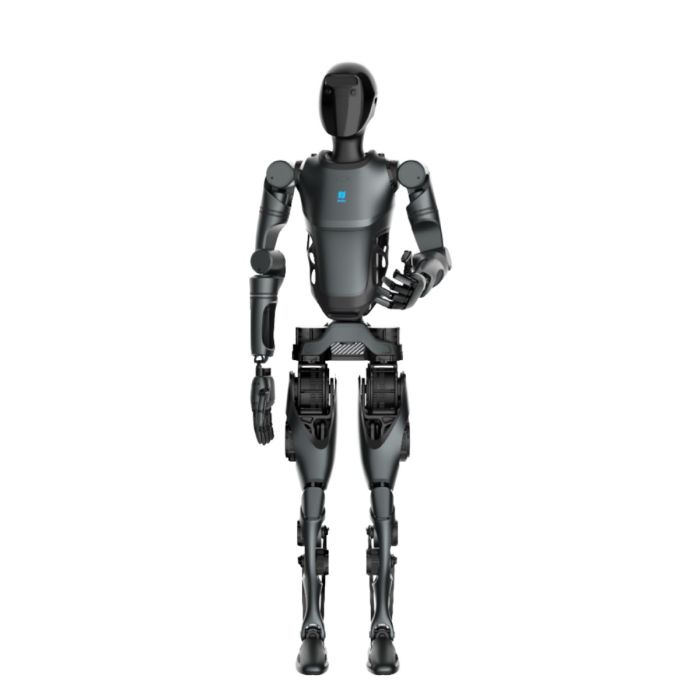
Pudu’s official product materials describe the D9 as an adult-proportioned humanoid with high-precision perception, advanced mobility performance, and an emphasis on continuously evolving capabilities.
Publicly disclosed headline specifications include 170 cm height, 65 kg weight, 42 degrees of freedom (DOF), maximum joint torque of 352 N·m, maximum walking speed up to 2 m/s, and a maximum payload of 20 kg in a test environment.
A key feature of the D9 is its integration with Pudu’s DH11 dexterous hand (an 11-DOF, five-finger end effector with tactile sensing), which is intended to enable complex grasping and manipulation tasks beyond simple grippers.
Design and Features
Full-scale humanoid proportions and bipedal locomotion
Pudu markets the D9 as a “full-scale” humanoid designed around adult body proportions and bipedal walking. This form factor is intended to help the robot operate in spaces built for people—corridors, stairs, doorways, and human-scale work areas—without requiring extensive infrastructure changes.
The product overview also publishes limb segment lengths (thigh/calf; arm/hand), suggesting a design focus on human-like reach and stride geometry for practical interaction with environments and objects.
High-precision end effector: PUDU DH11 dexterous hand
The D9 is described as being equipped with the PUDU DH11 dexterous hands. Pudu lists DH11 as an 11-degree-of-freedom hand (with 6 motorized/active DOF and 5 passive DOF) and tactile sensing features including 12 tactile sensing regions and 1018 tactile sensor pixels.
Pudu also publishes performance-style figures for DH11 such as 30 N maximum palm finger grip, 150 °/s palm finger bend speed, and 191 °/s thumb bend speed, positioning the hand as a manipulation component aimed at both speed and dexterity.
Sensor suite and onboard compute for perception
Pudu lists the D9’s onboard sensing as including RGB, RGBD, tactile sensors, and an IMU (inertial measurement unit). This combination is typical of humanoid platforms that must fuse vision, depth perception, touch feedback, and body dynamics to walk stably and manipulate objects.
The D9’s published compute figure is 275 TOPS, indicating a design intent to support on-device perception and model-based decision-making.
Technology and Specifications
Mobility, actuation, and payload
The D9 is specified with 42 total DOF, including single-leg DOF 6 and single-arm DOF 7, which implies multi-joint control for both locomotion and upper-body manipulation.
Pudu lists a maximum joint torque of 352 N·m and a maximum payload of 20 kg (with single-arm payload 10 kg) in a testing environment. These figures are commonly used to characterize how much force and load a humanoid can apply in lifting or tool-use contexts.
Power system
The published battery specification is 15 Ah (0.72 kWh). While runtime is not consistently published as a single number across official materials, this capacity figure is useful for estimating duty-cycle planning in early deployments and research environments.
Published “Product Overview” (official)
Pudu’s product page and official flyer list the following core specifications as part of the D9 overview (values reproduced here in narrative form): 170 cm height, 65 kg weight, 42 DOF, 352 N·m maximum joint torque, 20 kg maximum payload (test environment), 2 m/s maximum walking speed, 275 TOPS computing, sensors (RGB/RGBD/tactile/IMU), and 15 Ah (0.72 kWh) battery.
Applications and Use Cases
Human-scale manipulation and “embodied intelligence” R&D
Humanoid robots are frequently adopted first as R&D platforms because they combine two hard problems—locomotion and manipulation—into a single system. Pudu’s own framing of the D9 emphasizes ongoing evolution toward “commercially viable embodied intelligence,” implying iterative capability expansion rather than a fixed set of turnkey tasks.
Indoor service and facility scenarios
While Pudu’s public marketing materials emphasize capability (walking speed, dexterous hands, sensing, compute), they also present the D9 as suited to service-style environments where a humanoid form factor can be advantageous—particularly where tools and layouts are already designed for humans.
Logistics-adjacent demonstrations and mobility challenges
Third-party coverage at launch commonly described the D9 in the context of commercial tasks that benefit from bipedal motion—such as moving through varied terrain and navigating obstacles that challenge wheeled platforms—while still acknowledging that many detailed application claims depend on maturity and availability of software capabilities.
Advantages / Benefits
Compatibility with human environments
A full-sized bipedal humanoid can, in principle, operate where the world is optimized for people—stairs, narrow corridors, and human-height interfaces—without retrofitting the building for industrial robots. Pudu’s adult-proportioned design emphasis aligns with this goal.
Dexterous manipulation with tactile sensing
The DH11 hand’s tactile sensing regions and pixel count, combined with multi-DOF finger motion, are intended to support more nuanced grasping than simple parallel grippers—relevant to tasks involving irregular objects, delicate items, or tool handling.
On-device perception and control capacity
The sensor set (RGB/RGBD/IMU/tactile) and published compute rating (275 TOPS) support a design direction where perception and control can run onboard—important for robust real-world performance when connectivity is unreliable or latency-sensitive.
Iterative platform development
Pudu explicitly notes that the D9 is under continuous iteration and that promotional materials may differ from shipped versions, signaling an active development lifecycle. For organizations evaluating early humanoid deployments, this can be important for planning around software updates, capability roadmaps, and validation cycles.
FAQ
What is Pudu Robotics D9?
Pudu Robotics D9 is a full-sized bipedal humanoid robot designed for embodied intelligence applications, featuring 42 DOF, adult-scale proportions (170 cm), and dexterous DH11 hands with tactile sensing.
How does Pudu Robotics D9 work?
The D9 combines bipedal locomotion with multi-DOF arms and DH11 dexterous hands. It uses a sensor suite that includes RGB/RGBD vision, tactile sensors, and an IMU, supported by published onboard compute of 275 TOPS, to enable perception, balance, and manipulation.
Why is Pudu Robotics D9 important?
It represents Pudu’s move into full humanoid robotics, aiming to support commercially viable embodied intelligence where robots may need to navigate human environments and manipulate objects with tactile feedback and multi-finger dexterity.
What are the benefits of Pudu Robotics D9?
Commonly cited benefits include adult-scale bipedal mobility, a dexterous 11-DOF tactile hand, published 20 kg max payload (test environment), and a perception/compute stack designed for real-world sensing and control.
Summary
The Pudu Robotics D9 is Pudu’s first full-sized bipedal humanoid robot, built around adult-scale proportions, 42 degrees of freedom, and the DH11 tactile dexterous hand to pursue practical embodied intelligence in human environments. With published capabilities such as 2 m/s walking speed, 275 TOPS compute, and a 15 Ah (0.72 kWh) battery, the D9 is positioned as an evolving platform for advanced mobility and manipulation rather than a fixed-function service appliance.