
Astribot S1 Wheeled Humanoid Robot (S1)
In stock
- BRAND:
- ASTRIBOT
- PART #:
- S1
- ORIGIN:
- China
- AVAILABILITY:
- SUBJECT TO AVAILABILITY
- SKU:
- Astribot-S1
S1 Wheeled Humanoid Robot (S1)
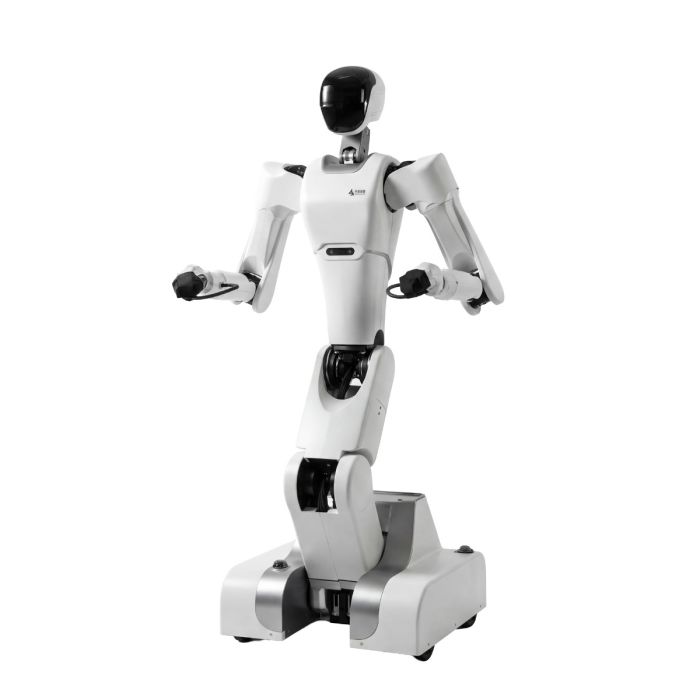
Unlike bipedal humanoids that rely on dynamic walking for mobility, the S1 uses a wheeled base paired with a human-like upper body. This design emphasizes stability, repeatability, and mobile manipulation in relatively structured environments (e.g., labs, offices, single-floor facilities).
Design and Features
Wheeled humanoid architecture
The Astribot S1 combines:
-
A human-like torso and head for sensor placement and expressive motion,
-
Two 7-degree-of-freedom (7-DoF) arms for bimanual manipulation,
-
A mobile base for navigation and repositioning during tasks.
Independent reporting describes the platform as a “mobile upper body sits on a wheeled base,” noting that wheel-driven mobility can be simpler and potentially less costly than full bipedal locomotion, while also limiting operation in stair-filled or multi-level homes.
End effectors and grasping
In research-oriented descriptions, the S1 is equipped with parallel-jaw grippers (a common choice for reliable, repeatable grasps in manipulation research).
Other coverage notes the use of simple two-finger grippers rather than fully anthropomorphic hands, reflecting a practical tradeoff: robust grasping and task completion over humanlike finger dexterity.
“Design for AI” toolchain orientation
Astribot frames the S1 around a “software–hardware integrated” approach aimed at AI development (“Design for AI, DFAI”), and highlights a research toolchain with APIs and development guidance designed to support data collection and model deployment.
Technology and Specifications
Publicly shared specifications vary by source and measurement method, but several details are consistently documented by primary or technical references.
Core kinematics (degrees of freedom)
A 2025 research paper describing “Astribot Suite” (a robot learning suite built around the S1 platform) specifies the following configuration:
-
Two 7-DoF arms, each with a parallel-jaw gripper
-
4-DoF articulated torso
-
2-DoF head
-
3-DoF omnidirectional mobile base
Manufacturer-published performance targets (selected)
Astribot’s product materials list several headline parameters for a research version of S1, including:
-
Height: ~170 cm
-
Weight: ~80 kg
-
Arm span: ~194 cm
-
Payload per arm (horizontal reach): 5 kg
-
Maximum end-effector velocity: ≥ 10 m/s
-
Maximum end-effector acceleration: ≈ 100 m/s²
-
Positioning repeatability: ± 0.1 mm
-
Endurance: 4–6 hours, with plug-in support
Some third-party reporting cites up to 10 kg per arm lifting capability, which may reflect different leverage conditions or test setups (e.g., closer to the body versus “horizontal reach” payload definitions).
Teleoperation and data collection
Teleoperation is emphasized as a practical pathway for collecting demonstrations used in imitation learning and visuomotor policy training. The Astribot Suite paper describes a whole-body teleoperation system using a VR headset and handheld controllers/joysticks, with both first-person and third-person control modes to balance precision and low-latency whole-body motion.
Applications and Use Cases
Because the Astribot S1 is presented as a general-purpose platform, its applications are often discussed in terms of capabilities rather than a single fixed workflow.
Robotics research and embodied AI
A primary use case is as a research robot for whole-body mobile manipulation, enabling work in:
-
Imitation learning from demonstrations
-
Vision-based manipulation policies
-
Bimanual coordination and long-horizon tasks
-
Benchmarking “embodied intelligence” systems in real environments
Service-robot prototyping (labs, offices, controlled facilities)
With an omnidirectional wheeled base and human-height reach, the S1 is often framed as a candidate platform for prototyping:
-
Object pickup and placement across work surfaces
-
Assistive delivery tasks in a facility
-
Light interaction tasks (opening doors, handling containers) in structured settings
Household-style demonstrations (concept validation)
Independent coverage describes demonstrations oriented toward household chores (e.g., preparing drinks or simple kitchen-like tasks), though these are generally best interpreted as capability demos rather than evidence of fully autonomous home deployment.
Advantages / Benefits
Practical mobility for manipulation
A wheeled base can provide:
-
Higher stability during manipulation compared with bipedal balancing
-
Simpler navigation on flat floors
-
Lower control complexity than dynamic walking, allowing engineering effort to concentrate on perception and manipulation
Research-friendly whole-body design
The combination of torso articulation, omnidirectional mobility, and bimanual manipulation supports “whole-body” behaviors (reach, posture changes, base repositioning) that are important for real-world tasks beyond tabletop manipulation.
Toolchain and teleoperation pipeline
A structured workflow—VR teleoperation → scalable data collection → learning and deployment—matches current best practices in robot learning, especially when building systems that must generalize across tasks and environments.
FAQ Section
What is the Astribot S1 Wheeled Humanoid Robot?
The Astribot S1 is a wheeled humanoid robot with a human-like upper body and dual 7-DoF arms, designed primarily as a platform for embodied AI research and whole-body manipulation experiments.
How does the Astribot S1 work?
The S1 combines an omnidirectional mobile base, an articulated torso and head, and two arms with grippers. It can be operated via teleoperation (including VR-based control) to collect demonstrations, which can then be used to train learning-based manipulation policies and deploy them on the robot.
Why is the Astribot S1 important?
It represents a trend toward general-purpose mobile manipulation: systems built not only to move, but to work—grasping, coordinating two arms, and performing multi-step tasks with whole-body motion. Its toolchain and teleoperation pipeline are aligned with modern robot-learning workflows.
What are the benefits of a wheeled humanoid robot like the S1?
Key benefits include stability, simpler mobility control, and strong suitability for indoor environments where floors are flat. This can reduce engineering complexity versus bipedal walking and shift focus toward manipulation, perception, and real-world task learning.
Summary
The Astribot S1 Wheeled Humanoid Robot (S1) is a research-focused, AI-oriented humanoid platform that prioritizes whole-body mobile manipulation through a stable wheeled base, articulated upper body, and dual 7-DoF arms. With an emphasis on VR teleoperation, scalable data collection, and learning-based control pipelines, it is positioned to support embodied AI experimentation and practical pilot applications in controlled indoor environments.