Unitree H2 EDU Humanoid Robot + Free Delivery (Coming Soon)
In stock
- BRAND:
- UNITREE ROBOTICS
- MODEL:
- H2 EDU
- ORIGIN:
- China
- Warranty:
- 12 MONTHS
- AVAILABILITY:
- PRE-ORDER
- SKU:
- Unitree-H2-EDU
Human-Scale Bipedal Architecture
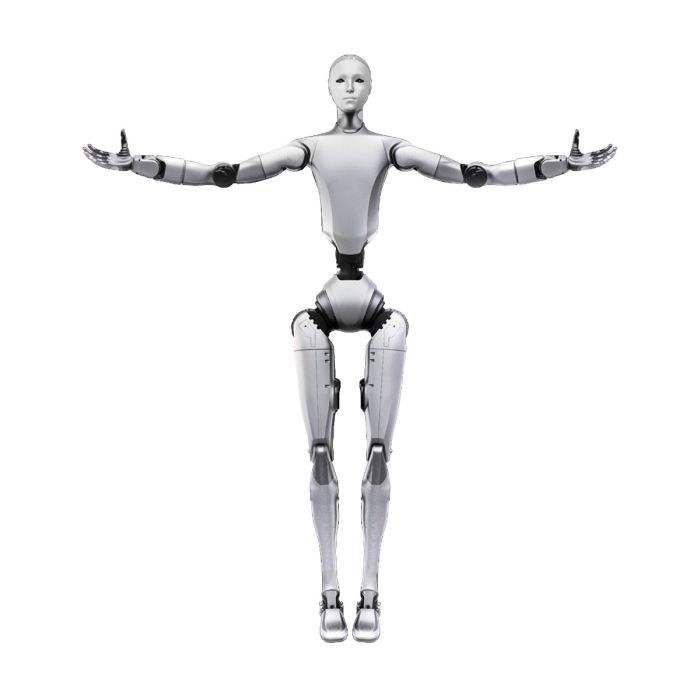
The H2 EDU's physical design centers on a 182-centimeter bipedal body with proportions calibrated to match an average adult male's height and limb ratios. The extended leg length compared to Unitree's H1 predecessor provides longer stride capability and improved passive stability from a higher center of mass moment of inertia, while maintaining comparable arm reach relative to torso height.
Arm subsystem (7 DOF each): Seven degrees of freedom per arm enables full shoulder-to-wrist articulation including three shoulder rotation axes, one elbow flexion axis, and three wrist orientation axes. This is the same 7-DOF configuration as the premium industrial humanoids from AgiBot and Boston Dynamics — the minimum required to reach any target orientation within the arm's workspace without singularities.
Leg subsystem (6 DOF each): Six degrees of freedom per leg covers the full hip-knee-ankle range required for stable bipedal walking, running, stair climbing, and the dynamic balance recovery demonstrated in the H2's training videos.
Waist subsystem (3 DOF): Three waist degrees of freedom — bending, twisting, and lateral tilt — enable whole-body motion coordination where the torso actively participates in balance and reach extension rather than remaining a passive rigid trunk.
Neck subsystem (2 DOF): Two neck degrees of freedom (pan and tilt) support visual tracking of targets during locomotion and manipulation, head orientation toward interaction partners during HRI scenarios, and natural head movement during locomotion that helps human observers perceive the robot's motion as fluid and organic.
Bionic Face and Human Presence Design
The H2 EDU's bionic sculpted face with animated eyes distinguishes it from the industrial aesthetic of most research humanoids. The face is not merely cosmetic: it serves as an active element of the robot's social interaction capability, with the animated eyes providing gaze cues that human interaction partners read as attention direction, and the human-proportioned facial geometry reducing the "uncanny valley" discomfort that starkly mechanical faces can produce in human subjects.
For research programs studying human-robot interaction, social robotics, affective computing, or the effects of robot anthropomorphism on human behavior, a platform with human-scale face design is a research instrument rather than an aesthetic choice.
Dexterous Hands: Included in EDU Package
The H2 EDU package includes dexterous hands — a configuration detail that matters significantly for research procurement. Unitree offers the DEX5-1 five-finger dexterous hand and the DEX3-1 three-finger force-controlled gripper as separate purchasable accessories for the base H2. Research teams studying manipulation, grasping, assembly, or object handover cannot work effectively without dexterous end-effectors, and the inclusion of hands in the EDU package simplifies budgeting and procurement for laboratory buyers.
Full Specifications Reference
| Specification | Unitree H2 EDU Value |
|---|---|
| Height | 182 cm (6'0") |
| Weight | Approximately 70 kg |
| Total Degrees of Freedom | 31 |
| Arm DOF | 7 per arm (bilateral) |
| Leg DOF | 6 per leg (bilateral) |
| Waist DOF | 3 |
| Neck DOF | 2 |
| Leg Peak Joint Torque | 360 N·m |
| Arm Peak Joint Torque | 120 N·m |
| Rated Arm Payload | 7 kg |
| Peak Arm Payload | Approximately 15 kg |
| Main AI Compute | 2,070 TOPS chip |
| Secondary Dev Hardware | Intel Core i7 (PC3 + PC4 expansion slots) |
| Wireless Connectivity | WiFi 6, Bluetooth 5.2 |
| Perception System | Stereo binocular cameras, IMUs, 3D LiDAR, depth camera |
| SDK Coverage | Python, C++, ROS 2 |
| OTA Software Updates | Yes (motion algorithms updated continuously) |
| Dexterous Hands | Included |
| Battery | Premium lithium, quick-swappable |
| Warranty | 12 months |
| Free Delivery | Yes (American Satellite; ToborLife) |
| North America Price | $68,900 USD |
| Federal Grant Eligible | NSF, NIH, DARPA, DOE |
| Production Start | March 2026 |
| Delivery Timeline | April 2026 / Q2 2026 |
The Intel Core i7 Secondary Development Environment
The Intel Core i7 secondary development computer in the H2 EDU is what operationally distinguishes this variant from the commercial platform for research purposes. Standard robotics development tools — Ubuntu Linux distributions, GCC and Clang compiler toolchains, Python 3.x with standard scientific computing libraries (NumPy, PyTorch, ROS 2 Python bindings), C++ build tools (CMake, colcon), and simulation interfaces — run natively on x86 hardware without requiring ARM cross-compilation, emulation layers, or custom build environments.
The PC3 and PC4 expansion slots in the Intel i7 configuration allow research teams to install custom PCIe add-in boards for specialized research hardware — additional GPU compute for on-robot neural network inference, custom sensor interface cards, FPGA boards for real-time control research, or communication interface cards for specialized experimental setups. This expandability makes the H2 EDU a platform that can grow with a research program's evolving hardware requirements rather than being limited to the fixed sensor and compute configuration at time of purchase.
2,070-TOPS Main AI Compute: Real-Time Policy Execution
The 2,070-TOPS main AI compute chip handles the real-time inference workloads that robot operation requires: visual perception processing from multiple camera streams, locomotion control policy execution (computing joint commands from sensor observations at control loop frequencies of 100 Hz or higher), voice interaction model inference, and any embodied AI manipulation policies running in active deployment.
At 2,070 TOPS, the H2 EDU's main compute matches the NVIDIA Jetson Thor specification — which represents 7.5 times the AI performance of the previous generation Jetson AGX Orin at substantially improved energy efficiency. This compute level is sufficient to run large vision-language-action models on-device for real-time manipulation policy execution, enabling the most advanced embodied AI research without requiring off-board cloud compute dependencies for inference.
ROS 2 Integration Architecture
Unitree implements ROS 2 compatibility through SDK2, which uses CycloneDDS as its underlying communication middleware — the same DDS (Data Distribution Service) implementation used as one of ROS 2's supported middleware options. This architectural alignment means that Unitree robot communication messages can be used directly in ROS 2 without requiring wrapper nodes to translate between separate communication protocols.
Unitree's GitHub organization (github.com/unitreerobotics) maintains the unitree_ros2 repository providing the ROS 2 package with CycloneDDS integration, message definitions (in the unitree_go and unitree_api subpackages), build scripts, and Docker development environment support via devcontainer configuration. Research teams can clone this repository and build it with standard colcon build tools into a standard ROS 2 workspace.
The practical workflow for an H2 EDU research team follows a standard ROS 2 pattern: connect the robot via Ethernet to the development computer, configure the network interface, source the ROS 2 environment, and run standard ROS 2 nodes that communicate with the robot through the CycloneDDS layer. Existing ROS 2 packages for navigation (Nav2), manipulation (MoveIt2), perception (robot_localization, point cloud processing), and visualization (RViz2) can be used with the H2 EDU without requiring robot-specific ports, substantially accelerating research setup compared to working with proprietary middleware environments.
Open-Source AI Framework: UnifoLM Series
Unitree has released several open-source AI components that extend the H2 EDU's research utility:
UnifoLM-WMA-0 provides a world-model-action architecture that enables the robot to maintain a predictive model of how the environment will respond to its actions — a capability relevant to research on model-predictive control, planning under uncertainty, and robot learning in dynamic environments.
UnifoLM-VLA-0, released January 29, 2026, provides a vision-language-action framework combining visual perception, natural language processing, and physical action generation. This framework enables research on language-grounded robot manipulation, where a human gives a natural language instruction ("pick up the red cup and place it on the tray") and the robot executes the corresponding physical sequence autonomously.
UnifoLM-WBT, released March 2026 as a living dataset, captures whole-body teleoperation demonstrations that support imitation learning research — training manipulation and locomotion policies from human demonstrations rather than programmatic specifications.
Applications and Use Cases
Bipedal Locomotion and Balance Control Research
Research groups studying novel bipedal locomotion algorithms — including reinforcement learning-based controllers, model predictive control for dynamic walking, terrain adaptation without explicit perception, and energy-efficient gait optimization — require a full-size, high-torque humanoid platform where algorithm performance translates to physical significance. The H2 EDU's 360 Nm leg torque and 31-DOF architecture provide the mechanical capability needed for dynamic locomotion research, while the full C++ SDK enables low-latency direct joint control necessary for developing and testing novel locomotion algorithms.
Language-Grounded Manipulation Research
The combination of UnifoLM-VLA-0, the Python SDK, and included dexterous hands positions the H2 EDU as a practical platform for research on language-grounded manipulation — teaching robots to execute physical tasks from natural language instructions using large language models and vision-language models as task planners and perception interpreters. This is one of the most active research frontiers in embodied AI, with direct connections to the practical challenge of making robots usable by non-expert operators.
Social Robotics and Human-Robot Interaction Studies
The H2 EDU's human-scale proportions, bionic face design, animated eyes, and voice interaction system make it a research instrument for social robotics studies. Research questions about how robot height and body proportions affect human comfort, how animated facial cues influence perceived robot attention and intention, and how humanoid robot appearance affects human willingness to engage in physical collaboration are all addressable with the H2 EDU's design without the confounds introduced by less human-like platforms.
Curriculum Development and STEM Education
The combination of ROS 2 compatibility, Python accessibility, a comprehensive SDK, and a 12-month warranty supporting continuous classroom use makes the H2 EDU suitable for advanced university robotics curricula. Students in graduate robotics programs and advanced undergraduate courses can develop locomotion controllers, manipulation pipelines, and HRI interaction systems with a physical full-size humanoid platform — providing experiential depth that simulation alone cannot replicate.
Teleoperation and Remote Operation Research
Unitree's teleoperation system integration with the H2 platform, documented in the UnifoLM-WBT dataset release and referenced in technical reviews, supports research on remote robot operation for hazardous environment access, disaster response, remote surgical support, and telepresence. Research teams can develop novel teleoperation interfaces, latency compensation algorithms, and shared-autonomy systems on the H2 EDU's full SDK.
Advantages and Benefits
Research-Grade SDK at Below-Research-Market Pricing: At $68,900, the H2 EDU undercuts the NEURA 4NE-1 Gen 3 (approximately $105,000), the Boston Dynamics Atlas (approximately $420,000), and the Agility Robotics Digit (approximately $250,000), while providing a full-size humanoid with competitive DOF count and compute specifications. For grant-funded research programs with constrained equipment budgets, the price differential enables either more units per budget or more remaining budget for supporting infrastructure.
Institutional Procurement Infrastructure: North American authorized distributors for the H2 EDU accept institutional purchase orders, provide formal quotes on dealer letterhead for grant budget documentation, support NET 30/60 payment terms for qualified institutions, and can provide sole-source justification language for procurement officers navigating university purchasing requirements.
OTA Algorithm Improvement: Over-the-air motion algorithm updates mean the H2 EDU's locomotion and base capabilities improve post-delivery without requiring hardware replacement — a sustained value that reduces the obsolescence risk of a research equipment investment over a 3 to 5-year research program lifecycle.
Expandable Compute Platform: The PC3 and PC4 expansion slots in the Intel i7 secondary compute environment provide hardware upgrade pathways that fixed-architecture platforms do not offer, allowing research teams to add compute, sensing, or communication capabilities as their programs evolve.
Frequently Asked Questions (FAQ)
What is the Unitree H2 EDU Humanoid Robot? The Unitree H2 EDU is the education and research configuration of the Unitree H2 humanoid robot, priced at $68,900 in North America with free delivery through distributors including American Satellite and ToborLife. It stands 182 centimeters tall with 31 degrees of freedom, 360 Newton-meters of leg joint torque, 120 Newton-meters of arm torque, and a 2,070-TOPS main AI compute chip. Exclusive to the EDU variant: an Intel Core i7 secondary development computer with PC3/PC4 expansion slots, full Python/C++/ROS 2 SDK, dexterous hands included, WiFi 6 and Bluetooth 5.2 connectivity, a 12-month warranty, and eligibility for NSF, NIH, DARPA, and DOE federal grant funding.
How does the Unitree H2 EDU differ from the H2 Commercial? Both variants share the same physical body (182 cm, 31 DOF, 360 Nm torque, bionic face). The H2 Commercial at $40,900 lacks SDK access, Intel i7 secondary development hardware, ROS 2 support, dexterous hands, and federal grant eligibility — it is appropriate for enterprise deployment through pre-built App Store applications. The H2 EDU at $68,900 includes all of these, making it the correct choice for research, custom algorithm development, manipulation studies, sensor integration, and any application requiring direct programmatic control of the robot.
Is the Unitree H2 EDU eligible for university research grant funding? Yes. The H2 EDU qualifies for most US federal research grant programs including NSF, NIH, DARPA, and DOE. It can be budgeted as "Major Research Equipment" or "Capital Equipment." Grant narrative justifications should emphasize the platform's specific research utility: full ROS 2 SDK enabling integration with the broader robotics research software ecosystem, 2,070-TOPS on-device AI compute enabling embodied AI model deployment research, Intel Core i7 secondary development environment for custom algorithm development, and dexterous hands enabling manipulation research. Institutional procurement advisors can provide guidance on sole-source justification language for university purchasing offices.
What ROS 2 support does the Unitree H2 EDU provide? The H2 EDU supports ROS 2 through Unitree SDK2, which uses CycloneDDS as its communication middleware — the same DDS implementation used natively in ROS 2. This architectural alignment enables direct use of Unitree robot messages in ROS 2 nodes without custom wrapper development. Unitree maintains the official unitree_ros2 GitHub repository (github.com/unitreerobotics/unitree_ros2) with package definitions, build scripts, Docker development environment support, and documentation. Standard ROS 2 packages for navigation (Nav2), manipulation (MoveIt2), perception, and visualization (RViz2) can be used directly with the H2 EDU within a standard ROS 2 workspace.
Summary
The Unitree H2 EDU Humanoid Robot represents the most price-competitive full-size, full-SDK humanoid research platform commercially available with free delivery as of Q2 2026. Its combination of human-scale 182-centimeter bipedal architecture with 31 degrees of freedom, 360-Newton-meter leg torque, 2,070-TOPS main AI compute, Intel Core i7 secondary development hardware with expandable PC3/PC4 slots, complete Python/C++/ROS 2 SDK, included dexterous hands, 12-month warranty, and federal grant eligibility addresses the complete practical requirements of university robotics programs, government research agencies, and corporate R&D teams studying bipedal locomotion, embodied AI manipulation, human-robot interaction, and related fields. Available with free delivery from American Satellite and ToborLife, with institutional purchase order support and confirmed Q2 2026 delivery, the H2 EDU offers research institutions a historically unprecedented combination of capability, developer accessibility, and price for a production-grade full-size humanoid research platform.
Specifications
General
Dimensions
Degrees Of Freedom
Robotics
Computing
Battery + Power
What's included
- Unitree H2 EDU Humanoid Robot
- Charger
- Smart Battery (Quick-release)
- Handheld Remote Controller
- Free Delivery